El Alamein War Museum: An Introduction
El Alamein War Museum is one of Egypt's principal places for exploring the history of the North African campaign during the Second World War. Located in El Alamein, it commemorates the fighting that took place across the surrounding desert in 1942. Its exhibitions combine military equipment, maps, personal objects and reconstructed scenes to explain events that affected Egypt, the Allied armies and the Axis forces. Although the museum focuses on a military confrontation, its importance also lies in remembering the people whose lives were changed or lost during the campaign.
Why El Alamein Became a Battlefield
El Alamein occupied a strategic position on Egypt's Mediterranean coast. The sea lay to the north, while the difficult terrain of the Qattara Depression restricted movement farther south. This geography made it harder for an attacking army to bypass defensive positions. During 1942, Axis forces advancing from Libya threatened Egypt and the routes that connected Britain to its strategic interests farther east. The defensive line at El Alamein became a place where the advance could be stopped, setting the stage for the battles that made the town internationally known.
The Battles of 1942
The fighting at El Alamein was not limited to a single engagement. Allied forces first held their defensive position during the summer of 1942. Later that year, the British Eighth Army, commanded by Bernard Montgomery, launched a major offensive against the German and Italian forces associated with Erwin Rommel. The Second Battle of El Alamein lasted from 23 October to 4 November 1942 and ended with an Allied victory. It changed the balance of the North African campaign and forced Axis forces to retreat westward.
How the Second Battle Unfolded
The Second Battle began with a major artillery bombardment on the night of 23 October 1942. Allied infantry and engineers then worked to open routes through heavily mined Axis defences during Operation Lightfoot. Progress was difficult, and the fighting developed into a prolonged struggle involving artillery, infantry and armour. A later offensive, Operation Supercharge, helped create the conditions for the final breakthrough. On 4 November, the Allied advance decisively broke the Axis position. Maps and military equipment help visitors connect these stages of the battle with the physical conditions of desert warfare.
The Open-Air Military Exhibition
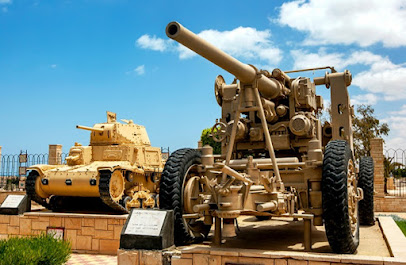
The museum's outdoor exhibition is among its most distinctive features. Tanks, artillery pieces, armoured vehicles and other heavy military equipment illustrate the machinery used by opposing armies in North Africa. The Egyptian Ministry of Defense also identifies aircraft and personnel carriers among the types of equipment represented in the outdoor display. Seeing these objects at close range offers a sense of their size and the logistical demands of operating them in desert conditions. The exhibition complements the maps, photographs and smaller artifacts presented inside the museum.
The Main Hall and Historical Interpretation
Inside the museum, the main hall introduces the wider military story. Wall decorations and representations of commanders include Bernard Montgomery and Erwin Rommel, while maps illustrate the North African theatre of operations. A central memorial connects the years of warfare with the desire for peace. According to the official museum description, exhibition information appears in Arabic, English, German and Italian. The combination of maps, imagery and multilingual interpretation helps visitors understand the campaign before exploring the country-specific galleries.
The Shared Gallery: Soldiers and Daily Life
The shared gallery brings together objects connected with participants from different countries. Rather than concentrating entirely on major weapons or commanders, it includes smaller possessions and models that suggest aspects of everyday military life. The official description identifies such items as a soldier's eating utensils and a personal religious book. These objects help reveal the practical and emotional dimensions of wartime service, reminding visitors that military campaigns involved individuals with daily routines, personal beliefs and experiences extending beyond the battlefield.
The Egyptian Gallery
The Egyptian gallery examines Egypt's position during the Second World War. Although the central fighting involved large Allied and Axis armies, the campaign took place on Egyptian territory and affected the country directly. The Ministry of Defense describes the gallery as addressing Egypt's logistical and field-related role under the arrangements that existed with Britain during the British occupation, as well as Egyptian wartime losses. This perspective is particularly important because the history of El Alamein cannot be understood only through the actions of foreign commanders and armies.
The British Gallery
The British gallery contains military maps, weapons, ammunition and representations of soldiers and officers associated with British forces in the North African campaign. Its displays help explain the organization and equipment of the Eighth Army and the multinational Allied formations serving alongside it. Looking at these materials in the context of the 1942 offensive helps visitors understand the coordination required for artillery attacks, infantry advances and armoured operations. The gallery also offers a way to consider how military planning translated into the experiences of individual service personnel.
The German Gallery
The German gallery presents maps, equipment, weapons and representations of German soldiers and officers who fought in North Africa. Some exhibits are associated with the German commander Erwin Rommel. The gallery provides an opportunity to examine the Axis side of the campaign, including the importance of armour, defensive positions and the problems created by extended supply lines. Its interpretation is best understood alongside the other galleries, which together explain the battle as a multinational conflict rather than the achievement or experience of one army alone.
The Italian Gallery
The Italian gallery documents the involvement of Italian forces in the North African campaign. Displays described by the Ministry of Defense include military insignia, models of soldiers and officers in different uniforms, weapons and ammunition. Italy's role was central to the wider conflict in North Africa, which began with the Italian invasion of Egypt in 1940 and later involved German intervention. The gallery helps visitors place Italian forces within the military coalition that confronted the Allies at El Alamein, while distinguishing their equipment and identity from those of their German partners.
Museum Development and Historical Memory
The museum was established during the presidency of Gamal Abdel Nasser to commemorate the battles and Egypt's place in their history. The Egyptian Ministry of Defense records a major reopening on 21 October 1992, around the fiftieth anniversary of the battle, followed by another reopening after exhibition improvements on 21 October 2014. These stages reflect an ongoing effort to preserve the collection and explain the events of 1942 to later generations. The museum functions both as a historical exhibition and as a place of remembrance.
War Cemeteries and Memorials Nearby
The museum forms part of a broader landscape of wartime remembrance around El Alamein. The nearby El Alamein War Cemetery and Alamein Memorial commemorate Allied and Commonwealth losses, while separate German and Italian burial and memorial sites are found farther west in the region. These are distinct places, not sections of the military museum. Visiting the museum before exploring the memorial landscape can provide useful historical context, while the cemeteries offer a quieter opportunity to reflect on the human cost of the fighting.
Planning a Meaningful Museum Visit
The museum stands in El Alamein along the Alexandria–Matrouh road corridor, south of the Mediterranean coastal road. Visitors interested in history can begin with the outdoor military equipment, continue through the introductory hall, and then compare the Egyptian, British, German, Italian and shared galleries. Reading the maps alongside the objects makes the sequence of the campaign easier to follow. Because visiting arrangements may change, opening times and admission prices should be confirmed directly rather than assumed from older travel information.