
Abydos: Sacred Landscape of Osiris and Royal Memory
Ancient Abydos, known in Egyptian as Abdju, developed into one of the most important sacred landscapes in Egypt. Its significance began long before the Temple of Seti I was built. At Umm el-Qaab, on the desert edge, rulers of the late Predynastic period and the kings of Egypt’s First Dynasty, along with two kings of the Second Dynasty, established royal tombs. This early association with Egypt’s first pharaohs gave Abydos an exceptional connection with royal origins and ancestral memory.
Over time, Abydos became the principal cult center of Osiris, the god closely associated with death, regeneration, and the afterlife. The ancient royal cemetery became incorporated into this religious landscape, and one of the early royal tombs at Umm el-Qaab came to be revered as the burial place of Osiris. A ceremonial route extended from the Osiris temple area toward the desert necropolis, while temples, commemorative chapels, tombs, and other ritual monuments accumulated around this sacred axis.
The importance of Abydos therefore combined two powerful ideas: the memory of Egypt’s earliest kings and devotion to Osiris. Kings continued to build and dedicate monuments there, while non-royal Egyptians also sought a connection with the site through tombs, chapels, stelae, offerings, and participation in the cult of Osiris. By the New Kingdom, when Seti I constructed his temple, he was building within a sacred landscape whose royal and religious traditions already extended back for more than two millennia. His monument deliberately participated in both traditions—a connection that becomes especially visible in its Osirian ritual program and its famous list of earlier kings.
Seti I and the Foundation of the Temple
Seti I, the second king of Egypt’s Nineteenth Dynasty, established his great temple at Abydos during the New Kingdom. The American Research Center in Egypt dates his reign to approximately 1290–1279 BCE and identifies the monument as a project begun under Seti I but left unfinished at his death. His son and successor, Ramesses II, subsequently completed substantial parts of the building and its decoration.
The temple was conceived within the exceptionally sacred environment of Abydos, where the cult of Osiris and the veneration of deceased kings were deeply interconnected. Its religious program incorporated several major Egyptian deities while also giving Seti I himself a dedicated sanctuary. ARCE notes that ritual scenes within the temple show the king presenting offerings and receiving divine symbols, while ceremonies performed in its chapels were connected with the transformation of the deceased Seti into Osiris, the divine model for the dead Egyptian king.
Seti I therefore placed his monument within both the Osirian religious tradition and the tradition of honoring Egypt’s royal ancestors. This relationship is expressed throughout the temple: in the sanctuary devoted to the deified Seti, the extensive Osiris complex, and the famous Abydos King List commemorating a selected sequence of earlier rulers. The temple was consequently more than a monument to an individual reign; its architectural and ritual program connected Seti I with the gods, deceased kingship, and the long sacred history of Abydos.
The finest portions completed under Seti I are also distinguishable artistically from later work. His sections are characterized by exceptionally refined raised relief, whereas areas finished under Ramesses II frequently employ sunk relief. These differences help identify successive phases in the temple’s construction and decoration. The Egyptian Ministry of Tourism and Antiquities additionally records that Ramesses II continued its decoration and that Merenptah, Seti I’s grandson, also contributed to the monument’s decorative history.
Construction and Later Decoration: Seti I, Ramesses II, and Merenptah
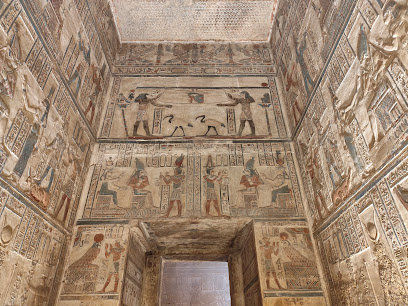
The Temple of Seti I was not completed in a single building campaign. Evidence from its decoration shows that work progressed substantially during Seti I’s reign, especially in the inner and most sacred parts of the monument. The seven principal chapels were sufficiently complete to have received their elaborate decoration before his death, and the Second Hypostyle Hall marks approximately the eastern limit of the fully decorated work completed under Seti I. Its walls preserve the exceptionally refined painted raised relief for which his temple is particularly renowned.
After Seti I died, his son Ramesses II continued and completed the monument. His intervention can often be recognized through his royal cartouches and by the greater use of sunk relief, contrasting with the exceptionally fine raised relief characteristic of many sections executed under Seti. Ramesses II decorated the temple's courts with scenes that included episodes connected with the Battle of Qadesh as well as representations of the king making offerings to the gods. He also altered access to the first hypostyle hall: of the seven gateways in its façade, six were closed, leaving the central entrance open.
The surviving monument also preserves evidence that completion was more complicated than simply replacing one king's craftsmen with another's. Research on the temple's southern annex has identified places where painted designs prepared under Seti I were only partially carved under Ramesses II, showing that unfinished decorative work from the father's reign could be inherited and continued by the son's workshops. Ramesses II also commemorated his role in finishing his father's monument in the Great Dedicatory Inscription at Abydos, which records his concern with Seti I's temple and its completion.
The Egyptian Ministry of Tourism and Antiquities states that the decorative program was subsequently continued by Merenptah, the son of Ramesses II and grandson of Seti I. Thus, the visible monument represents activity spanning three generations of the Nineteenth Dynasty: Seti I established and decorated its principal sacred core, Ramesses II undertook substantial completion and decoration after his father's death, and Merenptah contributed further work. The available authoritative sources are considerably more specific about the surviving work of Seti I and Ramesses II than about the exact temple surfaces attributable to Merenptah, so his contribution should not be assigned to particular rooms without more specific epigraphic evidence.
The Temple’s L-Shaped Plan, Courts, and Hypostyle Halls
The Temple of Seti I is architecturally distinctive for its unusual L-shaped ground plan. Built primarily of limestone, with sandstone used in some parts, the monument develops through a carefully ordered sequence of open courts, raised terraces, columned spaces, and increasingly restricted interior halls.
The original approach was from the northeast, through a large pylon that is now destroyed. Beyond it lay the first open court, which is also badly damaged. From this court, a stairway-ramp on the temple’s principal axis rose to a terrace containing a pillared hall. Three entrances at the rear of that hall led into the second court. The surviving decoration of the courtyards belongs largely to Ramesses II and includes scenes connected with the Battle of Qadesh as well as representations of the king presenting offerings to the gods.
A second stairway-ramp ascended to another raised terrace marking the approach to the temple’s roofed interior. A pillared portico formed the façade of this covered section. Behind it were seven gateways leading toward the First Hypostyle Hall. Ramesses II later blocked six of these entrances, leaving only the central doorway open.
The First Hypostyle Hall contains twelve pairs—twenty-four in total—of sandstone columns with papyrus-bud capitals. Seven further doorways originally connected this hall with the Second Hypostyle Hall, whose thirty-six columns are of a similar type. The second hall preserves finely executed scenes showing Seti I before the gods and forms the immediate architectural transition to the temple’s seven principal chapels.
This progression—from open courts to columned halls and then to individual sanctuaries—created a sequence in which access became increasingly focused as one moved deeper into the sacred interior. The unusual overall plan also accommodated additional cult spaces in the temple’s southern extension, including chapels and service or ceremonial areas that will be examined separately.
The Seven Chapels and Their Deities
Beyond the Second Hypostyle Hall lies one of the temple’s most distinctive features: seven parallel chapels forming its innermost sanctuary. They were dedicated, from south to north, to the deified Seti I, Ptah, Re-Horakhty, Amun-Re, Osiris, Isis, and Horus. The Egyptian Ministry of Tourism and Antiquities independently confirms these seven dedications, while the University of Chicago’s detailed publication of the temple divides its documentation between the chapels of Osiris, Isis, and Horus and those of Amun-Re, Re-Horakhty, Ptah, and Seti I.
The arrangement brought together several major strands of Egyptian religion. Ptah represented one of Egypt’s foremost creator and Memphite deities; Re-Horakhty expressed the solar cult; and Amun-Re, whose chapel occupied the central position in the row, was one of the most important state gods of the New Kingdom. Beside them stood the Abydos-associated divine family of Osiris, Isis, and Horus, while the seventh sanctuary was devoted to Seti I in deified form. The inclusion of the king alongside these major gods demonstrates how closely royal cult was integrated into the temple’s religious program.
The chapels were among the parts of the temple that reached an advanced state of completion during Seti I’s lifetime. Their walls show the king performing offerings and other ritual acts before the gods. In return, the divine figures present him with symbols associated with life, dominion, and kingship. These images were not simply decorative compositions: according to ARCE, they complemented ceremonies carried out by priests within the chapels and formed part of the ritual process through which the deceased Seti was identified with Osiris.
The position of the Osiris chapel is especially significant because it provides access to a further complex behind the main row of sanctuaries. This adjoining zone was devoted specifically to Osirian worship and contained additional halls, chapels, and restricted ritual spaces. The seven chapels therefore formed not an isolated sequence of rooms, but the principal sacred threshold between the hypostyle halls and the deeper cult areas of the temple.
The Osiris Complex and Its Restricted Ritual Spaces
The Chapel of Osiris differs from the other principal sanctuaries because it opens into an additional transverse complex devoted specifically to the cult of Osiris. According to the American Research Center in Egypt, this inner zone contains two halls and two groups of chapels, making it one of the most specialized religious areas within the Temple of Seti I.
Three small chapels adjoining the first hall were dedicated respectively to Osiris, Isis, and Horus. Together they represented the central divine family of the Osirian tradition. Their placement within the deeper part of the temple reflects the religious relationship between Osiris and Egyptian kingship: the living king was identified with Horus, while after death the king was associated with Osiris, ruler of the world of the dead. This theology was especially appropriate at Abydos, Egypt's principal center of Osiris worship.
Beyond these chapels lies an especially restricted two-pillared chamber. ARCE describes it as a secret chamber accessible only to the highest-ranking priests and identifies it as a place where the mysteries of Osiris were enacted. Its restricted access distinguishes it from the broader processional spaces of the temple and indicates that some ceremonies were intended for a very limited priestly group rather than for general participation.
The decoration and organization of the larger Osiris complex were connected with rituals concerning the god's death, regeneration, and renewed existence. Scholarly study of Egyptian temple ritual has further associated rooms in this part of the monument with ceremonies of the Khoiak festival, the annual cycle in which Osiris's regeneration was ritually represented. Some interpretations propose that particular inner rooms were used in preparing symbolic images of Osiris and carrying out funerary rites connected with them; because the precise use of individual rooms is reconstructed from reliefs and comparative ritual evidence rather than preserved operating records, these identifications should be treated as scholarly interpretations rather than absolute certainties.
The Osiris complex therefore formed a particularly sacred interior within the larger temple. The movement from the hypostyle halls, through the Osiris chapel, into increasingly secluded halls and chambers created a physical progression toward rituals centered on death, transformation, and regeneration. Within the overall program of Seti I's temple, those rites also reinforced the identification of the deceased king with Osiris.
The Southern Wing: Barques, Ptah-Sokar, Nefertem, and the Butchers’ Hall
The unusual L-shaped plan of the Temple of Seti I results in part from a substantial southern extension containing additional cult and service spaces beyond the seven principal chapels. Among the rooms identified in this wing are chapels associated with Ptah-Sokar and Nefertem, a Hall of the Barques, the unfinished Hall of the Butchers, and the passage containing the Abydos King List. Together, these spaces supported ceremonial activities that complemented the rituals performed in the temple’s main sanctuaries.
The Hall of the Barques was intended for the sacred portable boats used to carry divine statues during religious ceremonies and processions. Such barques allowed cult images normally housed within temple sanctuaries to participate symbolically in festivals and ritual movement. Their presence at Abydos reflects the importance of organized procession within the temple’s ceremonial program.
Nearby chapels were dedicated to Ptah-Sokar and Nefertem. Sokar was closely associated with funerary religion and, through the combined form Ptah-Sokar, belonged to a group of cults particularly appropriate to a monument concerned with death, royal transformation, and regeneration. Nefertem, another Memphite deity, was likewise incorporated into this southern group of chapels. Their inclusion demonstrates that the temple’s religious program extended well beyond the seven gods honored in its principal sanctuary.
Another remarkable space is the unfinished “Hall of the Butchers.” ARCE identifies it as the temple slaughterhouse, associated with preparing animal offerings required for ritual. Its unfinished condition provides an additional reminder that portions of the temple remained incomplete when Seti I died and that construction and decoration continued under his successors. The passage leading toward this area is particularly important because its west wall bears the celebrated Abydos King List.
ARCE further proposes that the southern wing was connected with the beginning of the temple’s ritual sequence. Priestly processions may have moved from this area toward the seven principal chapels and ultimately to the small sanctuary of Osiris. This reconstruction helps explain why rooms used for sacred barques, offerings, ancestral commemoration, and subsidiary cults were concentrated in a wing directly connected with the temple’s larger ceremonial program.
Reliefs, Painting, and the Artistic Style of Seti I’s Reign
The interior decoration of Seti I’s temple at Abydos is particularly noted for its exceptionally fine raised relief. The temple’s high-quality, fine-grained limestone allowed sculptors to cut extremely delicate details into figures, clothing, jewelry, hieroglyphs, and ritual objects. Art-historical research notes that details which might ordinarily have been supplied principally through paint could sometimes be rendered directly in the stone at Abydos because of the quality of the material and the precision of the carving.
Raised relief was produced by cutting away the surrounding stone so that the figures and inscriptions projected slightly from the background. Within Seti I’s monuments, this technique was especially associated with interior walls, although his reign also employed sunk relief in appropriate contexts. The distinction is important because Seti I did not exclusively use raised relief; rather, the carefully modeled raised reliefs of the Abydos temple represent some of the most accomplished surviving examples of his artistic program.
The carved surfaces were also painted, so the temple’s appearance in antiquity depended on the combined effect of sculpture and color. Surviving decoration in the Osiris Chapel has been documented with red, yellow, blue, green, and black pigments, while photographs and conservation studies demonstrate that substantial traces of ancient color remain visible in parts of the temple today. Painting supplied additional visual information and helped distinguish skin, garments, divine attributes, hieroglyphic signs, and ritual objects.
The decoration repeatedly depicts Seti I performing temple rituals before the gods: presenting offerings, burning incense, receiving divine symbols, and taking part in ceremonies associated with kingship and the cults honored at Abydos. The artistic refinement therefore served a religious purpose. Precise representations of the king, gods, offerings, and hieroglyphic texts formed part of a carefully organized ritual environment rather than functioning simply as ornament.
Differences in technique also help scholars distinguish phases of work. ARCE notes the contrast between the very fine raised relief associated with Seti I and the characteristic sunk relief found in portions completed by Ramesses II. The transition was not instantaneous: research on early Nineteenth Dynasty decoration indicates that Ramesses II initially continued to use raised relief in some projects before shifting strongly toward sunk relief early in his reign. At Abydos, traces of recutting and alteration can therefore preserve evidence of more than one stage of decoration.
For modern study, these differences in carving, inscriptions, royal names, unfinished designs, and surviving paint are important evidence for reconstructing how the temple was decorated across successive building campaigns. They also explain why the inner rooms completed under Seti I remain especially valuable for understanding the artistic standards and religious imagery of the early Nineteenth Dynasty.
The Abydos King List: Ritual Purpose and Historical Importance
The Abydos King List occupies the west wall of the passage leading from the Second Hypostyle Hall toward the Hall of the Butchers. It shows Seti I beside his son, Prince Ramesses—the future Ramesses II—facing rows of royal names. The first two registers contain 38 kings each, 76 in total, arranged broadly chronologically from Menes to Seti I.
The scene was not designed as a modern historical chronology. Its inscriptions place the royal names within an offering ritual. Seti I is represented presenting offerings to earlier kings, while Prince Ramesses holds a papyrus and recites a prayer. The accompanying texts invoke offerings of bread, beer, and other provisions for the deceased rulers through the benefaction of Seti I. ARCE therefore emphasizes that the list had a cultic rather than purely historical function and formed part of the invocation and commemoration of royal ancestors.
Its sequence is deliberately selective. The list omits the rulers of the Ninth and Tenth Dynasties and the early Eleventh Dynasty, as well as rulers of the Second Intermediate Period. It also excludes Sobekneferu, Hatshepsut, and the rulers associated with the Amarna period between Amenhotep III and Horemheb. The British Museum stresses that such omissions demonstrate that Egyptian temple king lists were not intended to provide an objective record of every ruler. Rather, they reflected which past kings were recognized within a particular royal and religious tradition.
This selectivity makes the list important for understanding ancient Egyptian ideas of legitimate kingship and royal memory. By presenting himself at the end of an honored succession of rulers and ritually supplying offerings to them, Seti I placed his own kingship within an approved ancestral line. The scene therefore connected religious commemoration with the continuity and legitimacy of the reigning dynasty.
At the same time, the Abydos King List is an important source for modern Egyptology. Some early rulers named in the Abydos lists are poorly documented elsewhere, making the monument useful for reconstructing parts of Egypt's royal sequence. Its historical value must nevertheless be used with caution: the list is valuable precisely because it preserves an ancient Egyptian selection of rulers, not because it constitutes a complete record of every pharaoh.
Scenes of the Death and Resurrection of Osiris
The Osirian decoration of Seti I’s temple should not be understood as a continuous illustrated narrative showing every episode of the myth of Osiris. Instead, the surviving reliefs concentrate on ritual manifestations of Osiris as a deceased, protected, and regenerated god, together with ceremonies through which Seti I was symbolically associated with him. ARCE explains that rituals performed in the temple were intended to transform the deceased king into Osiris, the divine identity traditionally assumed by dead Egyptian kings.
The published record of the Chapel of Osiris documents several important images. Seti I is shown presenting incense and other offerings to the seated Osiris and offering libations to the god’s sacred barque. Another relief depicts Osiris as an erect, embalmed figure standing within a small shrine, while another shows Osiris enveloped by the protective wings of Isis as Seti kneels before him with an offering. These scenes emphasize divine presence, preservation, protection, and renewed vitality rather than depicting Osiris simply as a lifeless corpse.
Other reliefs focus on Osiris’s sacred images and insignia. Seti offers incense to the god’s sacred emblem and presents the crook and flail to a seated Osiris. Such scenes formed part of the cultic service performed for the divine image. The combination of offerings, purification, divine regalia, and Osiris in mummiform or enthroned form presents his restored divine state through ritual rather than through a literal frame-by-frame retelling of his death.
The deeper Osiris Complex intensified this theme. It contained halls and subsidiary shrines devoted to Osiris, Isis, Horus, and Seti I, while a restricted two-pillared chamber was accessible only to high-ranking priests. ARCE identifies this chamber as the place where the mysteries of Osiris were enacted. The exact performance of those ceremonies cannot be reconstructed in every detail from the surviving monument, but their secluded setting demonstrates that important elements of the Osirian cult belonged to restricted priestly ritual. The extensive publication of this area by Calverley and Broome records an entire inner Osiris hall, further shrines, a second Osiris hall, and additional rooms, confirming that Osirian worship occupied a substantial architectural complex rather than a single chapel.
The underlying religious idea was closely connected with kingship. In Egyptian theology, Horus represented the living king, while the dead king was identified with Osiris. Within Seti I’s temple, the regeneration of Osiris therefore had a royal dimension: rituals centered on the god also supported the transformation and continuing divine existence of Seti after death. The temple’s Osirian imagery consequently joins the themes of divine regeneration, royal mortuary cult, and the sacred traditions of Abydos.
Royal Cult and the Ritual Journey Through the Temple
The Temple of Seti I was organized not only as a collection of sanctuaries but as a setting for repeated ritual action. Its reliefs show Seti I approaching gods, presenting offerings, burning incense, and receiving symbols of life, dominion, and kingship. These representations corresponded to ceremonies performed by priests within the temple and supported the continuing cult of the king. In the temple's religious program, the deceased Seti was ultimately identified with Osiris, following the traditional Egyptian association between the dead king and the ruler of the netherworld.
The architecture reinforced this ritual progression. Movement from the open courts passed through the First and Second Hypostyle Halls and eventually reached the seven principal chapels of Seti I, Ptah, Re-Horakhty, Amun-Re, Osiris, Isis, and Horus. The increasing depth of these spaces created a transition from relatively accessible ceremonial areas toward sanctuaries where priestly cult service took place. Beyond the Chapel of Osiris, access continued into an even more restricted Osirian complex, including a chamber that ARCE states could be entered only by the highest-ranking priests for the performance of the mysteries of Osiris.
Evidence also suggests a more specific processional route through the temple. ARCE proposes that rituals began in the southern extension, where the Hall of the Barques, subsidiary chapels, the Hall of the Butchers, and the Gallery of the Ancestors were located. From there, a procession of priests may have visited the seven principal chapels before ultimately reaching the small sanctuary of Osiris. Because this sequence is presented as a scholarly reconstruction rather than a surviving ancient itinerary, it is best described as a probable ritual route rather than an absolutely documented one.
Sacred barques were central to this ceremonial environment. The Hall of the Barques housed the portable boats used to carry statues of the gods during ceremonies. Movement of divine images enabled the gods to participate ritually in processions beyond their permanent sanctuaries, linking otherwise separate areas of the temple through ceremonial action.
Royal ancestor worship formed another element of this ritual system. In the Gallery of the Ancestors, Seti I and Prince Ramesses appear before the Abydos King List. The associated texts identify the scene as an offering ritual in which earlier rulers received provisions such as bread and beer through Seti I. ARCE therefore interprets the list primarily as part of a ceremony invoking royal ancestors rather than as a historical chronicle. By honoring selected predecessors, Seti also placed himself within a recognized succession of legitimate kings.
The king's own sanctuary added another dimension. Seti I was one of the seven beings honored with a principal chapel, appearing in deified form alongside major gods. The published temple record documents separate chapels for Amun-Re, Re-Horakhty, Ptah, and King Seti, as well as those of Osiris, Isis, and Horus. The arrangement placed royal cult directly within the temple's central sacred architecture rather than relegating it to a peripheral commemorative space.
The ritual journey through the temple therefore joined several related ideas: service to the gods, commemoration of royal ancestors, the divine status of kingship, and the posthumous transformation of Seti I. Architectural movement from courts to halls, chapels, and restricted Osirian rooms gave these concepts a physical setting. The surviving reliefs and inscriptions document many individual ceremonies, while the precise order in which all rituals were performed must sometimes be reconstructed from the architecture and religious program rather than treated as completely known.
The Osireion and Its Relationship to Seti I’s Monumental Complex
Directly behind the Temple of Seti I lies the Osireion, a remarkable subterranean monument constructed as part of Seti I’s complex at Abydos. Current archaeological and conservation work by the American Research Center in Egypt describes it as a subterranean granite structure built by Seti I, originally approached through the adjoining passage now known as the Merenptah Tunnel. Its position immediately behind the temple physically connects it with the king’s larger monumental program at Abydos.
Architecturally, the Osireion differs strikingly from the limestone temple in front of it. Its principal spaces employ enormous blocks of granite and sandstone, and its main hall incorporates water channels surrounding the central area. Recent conservation work has required bridges across these channels and structural reinforcement of monumental masonry near the so-called Sarcophagus Room. Archaeological clearance north of the monument has also revealed an ancient transport ramp cut into the bedrock, used to maneuver the massive stone blocks into position before the structure was backfilled.
The Osireion was deliberately constructed largely below the surrounding ground level, which gave it the character of an underground sacred monument. This feature, together with its massive architecture and Osirian context, distinguishes it sharply from the columned halls and decorated limestone chapels of Seti I’s main temple. UCL archaeological documentation identifies the Osireion as part of Seti I’s mortuary complex, while the classic archaeological publication by Henri Frankfort and his colleagues was titled The Cenotaph of Seti I at Abydos.
The term cenotaph reflects a long-standing interpretation of the monument as a symbolic or ritual tomb rather than Seti I’s actual burial place. Seti’s physical royal tomb was constructed in the Valley of the Kings at Thebes, while the Abydos monument existed within the sacred landscape of Osiris. The Osireion could therefore connect the king symbolically with the god whose cult dominated Abydos and with concepts of death, regeneration, and renewed existence. Its precise ritual function, however, remains incompletely understood; modern ARCE documentation explicitly describes the structure as “little-understood,” so highly specific reconstructions of ceremonies performed there should be treated cautiously.
The monument’s connection with Osiris was particularly appropriate at Abydos. By the New Kingdom, the city had long been one of Egypt’s principal centers for the worship of Osiris, and Seti I created a complex in which his own posthumous cult was repeatedly associated with the god. The Osireion extended that religious program beyond the decorated rooms of the main temple into a monumental subterranean setting closely associated with death and renewal.
The modern history of the Osireion is also significant. Flinders Petrie and Margaret Murray excavated it in 1902–1903, and later investigation produced increasingly detailed documentation of its architecture and inscriptions. Today it remains the subject of active archaeological conservation. Between 2023 and 2025, an ARCE project undertaken with the World Monuments Fund and Egypt’s Ministry of Tourism and Antiquities included 3D laser scanning, photogrammetry, structural conservation, archaeological clearance, and visitor-access improvements at the Osireion and Merenptah Tunnel.
The Osireion should therefore be understood neither as an unrelated monument behind the temple nor as evidence for an unidentified civilization predating Seti I. Current archaeological documentation places it firmly within Seti I’s New Kingdom monumental complex at Abydos. What remains open to scholarly interpretation is its exact ritual operation and the full meaning of its unusual subterranean architecture—not its association with Seti I and the Osirian sacred landscape.
The Temple Within the Wider Archaeological Landscape of Abydos
The Temple of Seti I forms only one part of the much larger archaeological and sacred landscape of Abydos. The site preserves monuments and occupation spanning many periods of Egyptian history, from the earliest royal dynasties through the Middle and New Kingdoms and into later antiquity. Seti I therefore chose a location whose religious authority had developed over many centuries rather than establishing an entirely new sacred center.
Farther into the western desert lies Umm el-Qaab, the cemetery containing the tombs of the kings of the First Dynasty, two rulers of the Second Dynasty, and earlier royal predecessors. In later Egyptian religious tradition, one of these ancient royal tombs came to be revered as the burial place of Osiris. This transformation connected Egypt's earliest royal cemetery with the cult that eventually made Abydos one of the country's most important pilgrimage centers.
Between the desert cemetery and the ancient settlement lay a sacred processional landscape. The principal temple of Osiris stood in the area now known as Kom el-Sultan, while a shallow desert valley extended toward Umm el-Qaab. Penn Museum research identifies this valley as the route followed by the great Osiris festival procession. Its religious importance was so strong that parts of the route were deliberately kept free of intrusive construction, allowing ritual movement between the Osiris temple and the location regarded as the god's tomb.
Abydos also preserves monumental evidence for the cult of Egypt's earliest kings outside their actual tombs. North Abydos contained large royal funerary enclosures built of mud brick. The best-preserved example is Shunet el-Zebib, constructed for the Second Dynasty king Khasekhemwy. Archaeological investigation has revealed large-scale offering activity associated with the enclosure, while nearby discoveries include Early Dynastic royal enclosures and graves constructed for boats. These monuments demonstrate that Abydos was already a major center of royal ritual long before the rise of the Osiris cult or the construction of Seti I's temple.
The Middle Kingdom added another important layer to this sacred landscape. Archaeologists have excavated numerous memorial chapels associated with individuals who wished to participate perpetually in the cult and festival of Osiris. These were not ordinary tombs: excavated examples lacked burial shafts and funerary equipment and instead contained commemorative material positioned in relation to the processional route. At South Abydos, King Senwosret III also constructed a royal mortuary complex and tomb associated with his devotion to Osiris-Khentiamentiu.
The New Kingdom further transformed Abydos. Close to Seti I's monument stands the Temple of Ramesses II, whose surviving precinct has been the subject of extensive modern excavation and conservation. Recent work has exposed its surrounding enclosure walls, temple palace, storage magazines, and other components; the excavated precinct measures approximately 100 by 90 meters and contained 42 magazines. These discoveries show that the New Kingdom temples at Abydos functioned as substantial religious institutions with administrative and economic facilities as well as sanctuaries.
Seen within this wider setting, Seti I's temple occupies a deliberate position in a landscape already saturated with royal memory, pilgrimage, ancestor cult, and Osirian ritual. Its Abydos King List evoked earlier kings; its Osiris chapels participated in the city's dominant religious tradition; and the adjoining Osireion extended the connection between the king and Osiris. The monument is therefore best understood not in isolation, but as a New Kingdom expression of religious ideas rooted in an archaeological landscape whose significance reached back to the beginnings of Egyptian kingship.
Documentation, Conservation, and the Temple Today
The Temple of Seti I has been the subject of unusually detailed archaeological documentation for more than a century. A major milestone began in the 1920s, when the Egypt Exploration Society transferred work to Abydos and Amice M. Calverley, later assisted by Myrtle F. Broome, undertook the painstaking recording of the temple's reliefs. In partnership with the Oriental Institute of the University of Chicago, the project ultimately produced four major volumes documenting the seven chapels, the Osiris Complex, and the Second Hypostyle Hall. Together they contained 231 plates, including detailed reproductions that remain an important scholarly record of the monument's inscriptions, reliefs, and surviving colors.
This documentation is particularly valuable because the temple's decorated surfaces are vulnerable to gradual deterioration. A 2023 condition assessment of the Osiris Chapel examined its painted reliefs using microscopy, X-ray diffraction, SEM-EDX, and other analytical techniques. Researchers identified Egyptian blue and Egyptian green pigments, red and yellow ochres, and a gypsum preparation layer. The study also documented deterioration including substantial soot accumulation, as well as the effects of some previous coatings and interventions. Its authors emphasized systematic recording of the condition of the paintings as a basis for conservation decisions.
Conservation has also involved direct treatment of important temple spaces. Egypt's Ministry of Tourism and Antiquities has reported the completion of restoration work in the Chapel of Amun-Re, one of the temple's seven principal sanctuaries, by a team of conservators and archaeologists from the Supreme Council of Antiquities. Earlier heritage-preservation work at the temple included both physical conservation and programs intended to increase awareness of the importance of Abydos among the surrounding community.
Digital recording now supplements traditional epigraphic documentation. During conservation work at the adjoining Osireion in 2023, specialists carried out 3D laser scanning and photogrammetry, including selected internal areas of Seti I's temple. The resulting high-resolution digital record provides a baseline against which future changes in the condition of the monument can be assessed and offers new possibilities for archaeological study and presentation.
The preservation challenge extends beyond individual reliefs. The surviving temple includes finely carved limestone, sandstone architectural elements, ancient pigments, damaged exterior courts, and underground or low-lying structures in the associated complex. Conservation therefore requires a combination of archaeological recording, materials analysis, structural intervention, environmental monitoring, and careful management of visitors rather than a single type of restoration treatment. Modern research also demonstrates why surviving color should be treated as an integral component of the monument rather than as a secondary decoration.
The Temple of Seti I remains an officially open archaeological site. As of 20 September 2026, the Egyptian Ministry of Tourism and Antiquities lists the temple at Arabat Abydos, El Balyana, Sohag, with regular visiting hours of 7:00 a.m. to 5:00 p.m., noting that last admission is one hour before closing and that separate Ramadan hours apply. The Ministry also provides an electronic ticketing option. Because opening arrangements can change, visitors should verify the official information shortly before travel.
The temple visible today is therefore both an ancient religious monument and an actively studied heritage site. The early painted and line-copy documentation preserves a detailed record of its decoration, while modern scientific analysis, restoration, and digital surveying help monitor and protect what survives. These efforts are especially important at Abydos because the value of the monument lies not only in its architecture, but also in the exceptionally delicate relief carving, inscriptions, and ancient pigments that preserve the ritual program of Seti I's temple.