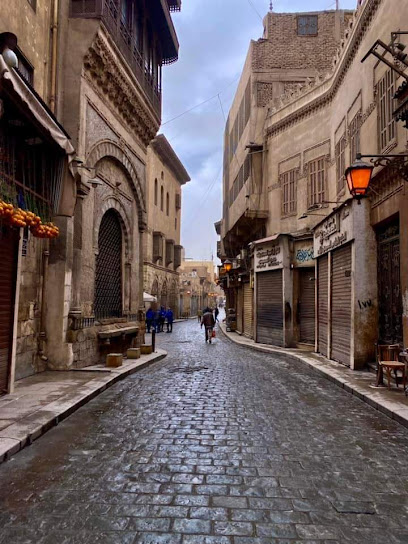
A Historic Street at the Heart of Cairo
Al-Muizz li-Din Allah Street runs through the historic nucleus of Cairo, connecting two surviving gates of the medieval city. Its continuous streetscape brings visitors face to face with mosques, religious schools, mausoleums, former public fountains, and domestic buildings from different centuries. Unlike an isolated archaeological monument, the street remains part of an inhabited and commercially active neighbourhood. The combination of major architectural landmarks and everyday urban life is central to its identity. Walking along the route reveals how successive generations built within, adapted, and preserved the original framework of Fatimid Cairo.
Fatimid Origins and the Name Al-Muizz
The street's origins are linked to the foundation of Cairo in 969 CE, when the Fatimids established a new capital north of Fustat. The city was created under the authority of Caliph al-Muizz li-Din Allah, with the commander Jawhar al-Siqilli directing its establishment. The principal north–south thoroughfare became an important axis of the new city. Over time, different stretches were associated with their neighbourhoods, markets, and historic functions. According to Egypt's Ministry of Tourism and Antiquities, the street acquired the name al-Muizz in 1937 in honour of the caliph.
From Bab al-Futuh to Bab Zuwayla
The historic route extends from Bab al-Futuh at the northern end to Bab Zuwayla at the southern end. These gates provide clear geographical landmarks for understanding the street as a connected urban corridor. Bab al-Futuh was built under the vizier Badr al-Jamali in 1087 CE, while Bab Zuwayla dates to 1092 CE. Their massive stone structures illustrate the military architecture of the later Fatimid period. Between them, smaller lanes connect the main thoroughfare to the surrounding districts, including al-Gamaliyya, Darb al-Asfar, Khan al-Khalili, and al-Ghuriyya.
The Northern Quarter and Al-Hakim Mosque
Close to Bab al-Futuh stands the Mosque of al-Hakim bi-Amr Allah, one of the important surviving religious buildings of Fatimid Cairo. Construction began under Caliph al-Aziz in 990 CE and was completed under his son al-Hakim in 1013 CE. The mosque has a spacious courtyard, arcades, prominent entrance architecture, and two minarets. It originally stood outside an earlier line of Cairo's walls but became enclosed by the expanded fortifications. Its position near the northern gate makes it a natural starting point for exploring the street's earliest architectural layers.
Al-Aqmar Mosque and Fatimid Stone Decoration
Further along the street, al-Aqmar Mosque provides a particularly significant example of Fatimid decorative architecture. Commissioned in 1125 CE under Caliph al-Amir bi-Ahkam Allah, it is celebrated for its elaborately carved stone façade. Kufic inscriptions, religious phrases, and carefully organised ornamental compositions reveal the importance of symbolic decoration in Fatimid architecture. The façade follows the alignment of the street while the internal prayer orientation remains appropriately directed. This relationship between the urban frontage and the building's religious function is one of the mosque's distinctive architectural achievements.
Bayn al-Qasrayn and the Monumental Mamluk Streetscape
The Bayn al-Qasrayn area, whose name refers to the space between the former Fatimid palaces, became one of Cairo's most prestigious settings for later monumental construction. Although the original palaces did not survive as complete buildings, their former urban setting continued to shape the street. Mamluk rulers sponsored large religious and charitable complexes here, placing imposing portals, minarets, domes, and decorated walls directly against the main thoroughfare. The concentration of buildings allows visitors to compare artistic approaches from different reigns within a relatively compact historic setting.
The Qalawun Complex and Sultan Barquq
The complex of Sultan al-Mansur Qalawun, established in 1283–1284 CE, combines religious education, commemoration, and medical care within an ambitious architectural foundation. Its surviving fabric includes richly decorated entrances and monumental spaces associated with the madrasa, mausoleum, and bimaristan. Nearby, the madrasa and khanqah of Sultan al-Zahir Barquq, built between 1384 and 1386 CE, demonstrate another phase of Mamluk architectural patronage. Its courtyard, iwans, religious teaching spaces, and funerary elements illustrate the varied purposes served by these institutions. Together, the complexes reveal how rulers expressed authority through public architecture.
Sabils, Kuttabs, and Public Welfare
Not every important structure on al-Muizz Street was a grand mosque or royal mausoleum. Public drinking fountains, known as sabils, and small teaching institutions called kuttabs also contributed to the daily life of the neighbourhood. The Sabil-Kuttab of Abd al-Rahman Katkhuda, established in 1744 CE, stands at the intersection of al-Muizz and Tambakshiya streets. Its distinctive façades, drinking windows, and upper teaching space illustrate a traditional arrangement combining access to water with education. Such buildings make the street an important place for understanding charitable foundations and practical urban services.
Bayt al-Suhaymi and Domestic Architecture
The heritage of al-Muizz extends beyond public religious buildings. In nearby Darb al-Asfar stands Bayt al-Suhaymi, an important surviving example of Cairene domestic architecture. Its earlier section dates to 1648 CE, with a later addition from 1796 CE. The house contains courtyards, reception spaces, wooden mashrabiyya screens, and domestic service areas that illustrate the organisation of an affluent urban residence. It provides a valuable contrast to the monumental façades of the street, revealing how privacy, ventilation, hospitality, and family life influenced the design of traditional Cairo houses.
Al-Ghuriyya and the Southern Approach
Toward the southern part of the route, the architectural setting changes again around the complex of Sultan Qansuh al-Ghuri. Constructed in 1503–1504 CE, this late Mamluk foundation brings together religious, educational, funerary, and charitable functions. Its buildings occupy opposite sides of the street, highlighting the relationship between monumental architecture and commerce. Continuing south leads toward Bab Zuwayla, one of the most recognisable surviving gates of Fatimid Cairo. Its later association with the minarets of the Mosque of al-Muayyad Shaykh shows how older structures were incorporated into the city's continuing architectural history.
Markets, Craft Traditions, and Living Heritage
Al-Muizz Street should be understood as more than a sequence of monuments. Commercial activity, traditional shops, and the neighbouring market lanes remain essential to the experience of the district. Crafts, retail spaces, and the movement of local residents continue patterns that have characterised Historic Cairo for centuries, even as the forms of trade have changed. Architectural details reward close attention, but so do the transitions between narrow lanes, open spaces, shops, and historic façades. Respectful exploration helps visitors appreciate that this heritage environment is also a place where people work, worship, and live.
UNESCO Recognition and Responsible Exploration
The street lies within Historic Cairo, the wider property inscribed on the UNESCO World Heritage List in 1979. The inscription belongs to Historic Cairo as an urban heritage ensemble, not to al-Muizz Street as a separate World Heritage property. UNESCO recognises the area's exceptional architectural inheritance and surviving historic urban fabric, including the north–south axis of the Fatimid city. A thoughtful visit can begin at either historic gate and follow the changing architecture through the surrounding neighbourhoods. Visitors should respect active places of worship, residential privacy, and monument-conservation arrangements, which may vary between individual buildings.