
Al Emam El Hussein Mosque: A Historic Shrine in the Heart of Cairo
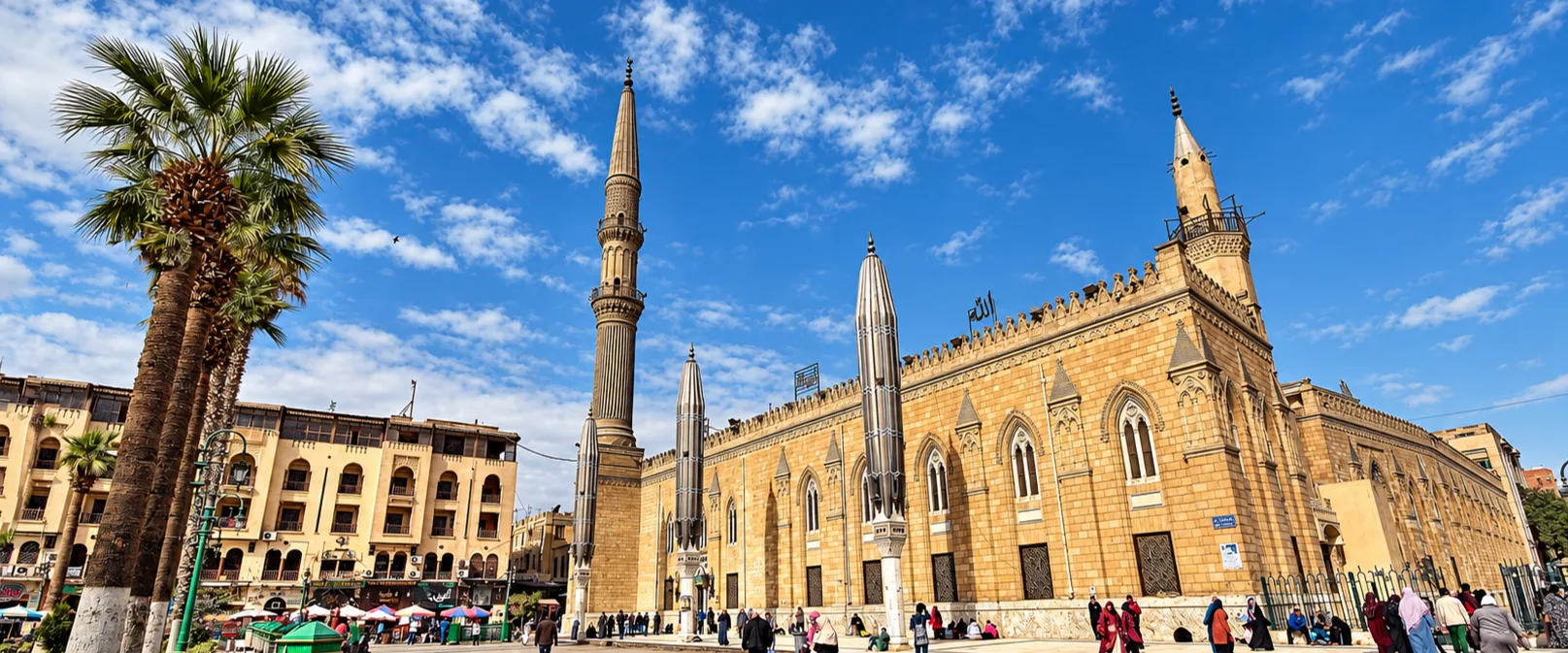
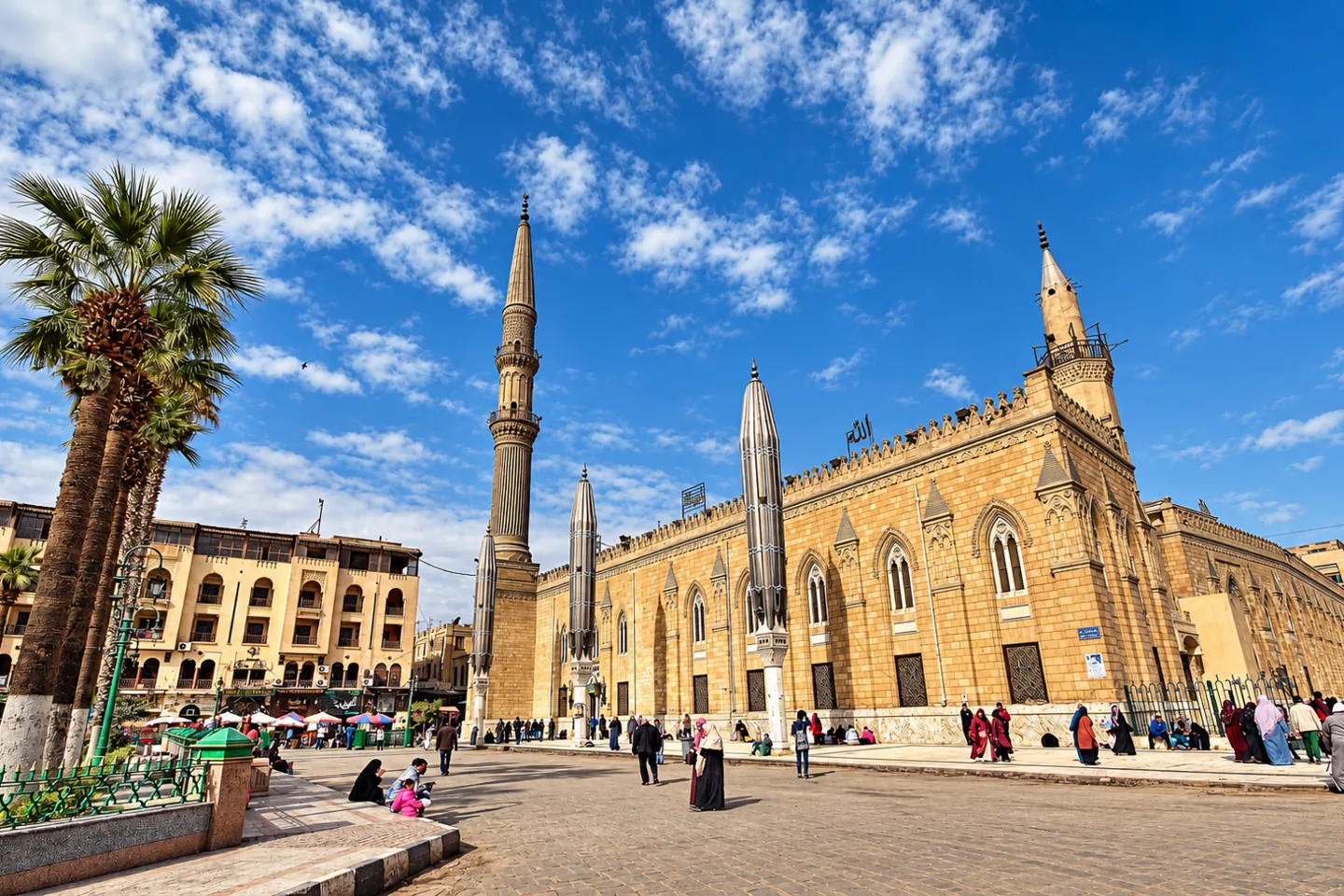
Al Emam El Hussein Mosque stands in Cairo's Al-Hussein district, immediately associated with the historic urban environment of Khan Al-Khalili and nearby Al-Azhar Mosque. Egyptian official sources describe it both as a mosque and as the site of a historic mashhad or shrine connected with Imam Hussein ibn Ali, the grandson of the Prophet Muhammad. Its documented architectural history begins in the Fatimid period, while the building visible today reflects several later phases of rebuilding and enlargement.
The mosque belongs to the wider setting of Historic Cairo, a World Heritage property inscribed in 1979. UNESCO describes the historic city as an exceptional surviving Islamic urban landscape of mosques, madrasas, shrines, markets and residential quarters, and explicitly includes the shrine of Al-Hussain among the city's prominent religious monuments. Egypt's Ministry of Tourism and Antiquities likewise emphasizes Historic Cairo's continuously inhabited urban fabric and its concentration of religious, commercial and historic buildings.
The importance of Al-Hussein Mosque therefore extends beyond a single architectural period. It combines a Fatimid foundation, later medieval remains, nineteenth-century reconstruction and an enduring religious function within one of Cairo's most historically significant districts. Claims concerning the presence of Imam Hussein's head at the site belong to a long-established religious and historical tradition and will be treated separately from securely documented architectural history in the following section.
Fatimid Foundation in 549 AH / 1154 CE
The documented history of Al Emam El Hussein Mosque begins in the Fatimid period. Egypt’s Ministry of Awqaf states that the mosque was established in 549 AH / 1154 CE under the supervision of the Fatimid vizier Al-Salih Tala'i. The State Information Service gives the same date and attribution, providing an independent official confirmation of this foundation phase.
This twelfth-century foundation formed the nucleus of the later shrine and mosque complex, although the building visible today is not a wholly preserved Fatimid structure. Subsequent rulers and patrons altered, enlarged, and rebuilt parts of the site over many centuries. The mosque’s present appearance therefore reflects a long architectural history layered over its Fatimid origin.
The foundation date is especially important because it places the site within the final decades of Fatimid rule in Egypt, shortly before the end of the dynasty in 1171. Official Egyptian accounts then record a new phase under Salah al-Din al-Ayyubi, who established a school beside the shrine after the Fatimid period.
The Tradition of Imam Hussein’s Head and the Move from Ascalon
The association between Al Emam El Hussein Mosque and Imam Hussein ibn Ali rests on a long-established religious and historical tradition concerning the location of his head after his death at Karbala. Egyptian official sources do not present the Cairo burial as an independently proven archaeological fact; instead, they explicitly attribute it to accounts transmitted by a number of Egyptian historians.
According to the account presented by Egypt’s Ministry of Awqaf, the head was believed to have been kept at Ascalon (Ashkelon) in Palestine. With the beginning of the Crusades, the Fatimid ruler of Egypt was said to have feared that it might be harmed there. The account states that it was consequently brought from Ascalon to Egypt, buried at the present site in Cairo, and that the shrine was established over it. The State Information Service and Cairo Governorate reproduce substantially the same tradition.
This tradition helps explain both the name of the mosque and its exceptional devotional importance. At the same time, historical traditions concerning the final location of Imam Hussein’s head are not uniform. For that reason, the most accurate presentation is to distinguish between the documented existence and architectural development of the Cairo shrine and the religious-historical tradition identifying it as the burial place of the head. Cairo Governorate likewise uses cautious language, stating that the shrine is believed to contain it.
From the Ayyubid Period to the Medieval Mashhad
The end of Fatimid rule in Egypt in 1171 CE brought the shrine into a new political and religious context under Salah al-Din al-Ayyubi. Egyptian official sources state that Salah al-Din established a school beside the shrine, which became associated with the mashhad. That school was later demolished, and the present mosque was eventually constructed in its place.
This Ayyubid phase did not erase the earlier shrine. Instead, the site continued to develop around it. By the late Ayyubid period, new construction was being added to the complex, most notably a minaret begun in 1235 CE above the gate of the mashhad, today known as the Green Gate. The work was initiated by Abu al-Qasim ibn Yahya ibn Nasr al-Sukkari, known as al-Zarzur, and completed by his son in 1236 CE after his death.
These additions show that the site remained architecturally active well after the Fatimid period. Although much of the medieval complex was later altered or replaced, the surviving remains help preserve evidence of the mosque’s layered development from Fatimid shrine to Ayyubid religious complex and, eventually, to the substantially rebuilt nineteenth-century mosque.
The Surviving Ayyubid Minaret Base
One of the clearest surviving medieval elements at Al Emam El Hussein Mosque is the square base of the Ayyubid minaret above the entrance now known as the Green Gate. Egypt’s State Information Service and Ministry of Awqaf state that Abu al-Qasim ibn Yahya ibn Nasr al-Sukkari, known as al-Zarzur, began the minaret in 1235 CE and that his son completed it in 1236 CE after his death.
The upper parts of the medieval minaret did not survive intact. What remains is the square base, together with two marble commemorative inscriptions recording the date of construction and the name of the builder. The CULTNAT database of Islamic Cairo identifies this minaret as one of the oldest surviving archaeological elements associated with the mosque and notes that its upper sections were destroyed and renewed in later periods.
The base is especially valuable because it preserves physical evidence of the mosque’s Ayyubid phase within a complex that was substantially rebuilt in later centuries. Its survival beside the Green Gate provides a tangible link between the medieval mashhad and the later nineteenth-century mosque.
Abd al-Rahman Katkhuda and the Eighteenth-Century Renovation
A major phase in the history of Al Emam El Hussein Mosque took place in the eighteenth century under Amir Abd al-Rahman Katkhuda, one of the most prominent patrons of religious architecture in Ottoman-period Cairo. Cairo Governorate records that he rebuilt and enlarged the mosque, adding two iwans as well as water-related facilities to the complex.
The best-documented work associated with Katkhuda at Al-Hussein dates to 1175 AH / 1761–1762 CE. Sources describing the surviving medieval fabric state that he renewed the upper part of the earlier minaret and also renovated the mashhad and the dome over the shrine. The interior of that dome was decorated with colored and gilded ornament, while the mihrab area and lower walls received colored marble revetment.
These eighteenth-century interventions were important because they preserved and reshaped the shrine before the far more extensive nineteenth-century reconstruction ordered by Khedive Ismail. Some elements created under Katkhuda were themselves later altered: Cairo Governorate notes, for example, that restoration work in the early 1980s replaced the cap of the shrine dome associated with his 1761 renovation.
Khedive Ismail and the Construction of the Present Mosque
The most decisive transformation of Al Emam El Hussein Mosque took place in the nineteenth century. In 1862, Khedive Ismail ordered the renewal and enlargement of the historic mashhad and the construction of the present mosque. Egypt’s Ministry of Awqaf and State Information Service both record that the main building works were completed in 1873.
The reconstruction was not limited to the prayer space itself. Official accounts state that Khedive Ismail also ordered the enlargement of the mosque’s surrounding open areas and access routes, integrating the religious complex more fully into the urban fabric around Al-Hussein. Cairo Governorate describes this rebuilding campaign as lasting approximately ten years, confirming its scale and importance in the mosque’s development.
A few years after completion of the main mosque, a new minaret was built in 1878. Official sources describe it as being designed in the Ottoman style. This nineteenth-century minaret, together with the rebuilt mosque, became a defining part of the complex’s present appearance, while earlier medieval elements—such as the Ayyubid minaret base—continued to survive alongside it.
Abd al-Rahman Katkhuda and the Eighteenth-Century Renovation
A major phase in the history of Al Emam El Hussein Mosque took place in the eighteenth century under Amir Abd al-Rahman Katkhuda, one of the most prominent patrons of religious architecture in Ottoman-period Cairo. Cairo Governorate records that he rebuilt and enlarged the mosque, adding two iwans as well as water-related facilities to the complex.
The best-documented work associated with Katkhuda at Al-Hussein dates to 1175 AH / 1761–1762 CE. Sources describing the surviving medieval fabric state that he renewed the upper part of the earlier minaret and also renovated the mashhad and the dome over the shrine. The interior of that dome was decorated with colored and gilded ornament, while the mihrab area and lower walls received colored marble revetment.
These eighteenth-century interventions were important because they preserved and reshaped the shrine before the far more extensive nineteenth-century reconstruction ordered by Khedive Ismail. Some elements created under Katkhuda were themselves later altered: Cairo Governorate notes, for example, that restoration work in the early 1980s replaced the cap of the shrine dome associated with his 1761 renovation.
Khedive Ismail and the Construction of the Present Mosque
The most decisive transformation of Al Emam El Hussein Mosque took place in the nineteenth century. In 1862, Khedive Ismail ordered the renewal and enlargement of the historic mashhad and the construction of the present mosque. Egypt’s Ministry of Awqaf and State Information Service both record that the main building works were completed in 1873.
The reconstruction was not limited to the prayer space itself. Official accounts state that Khedive Ismail also ordered the enlargement of the mosque’s surrounding open areas and access routes, integrating the religious complex more fully into the urban fabric around Al-Hussein. Cairo Governorate describes this rebuilding campaign as lasting approximately ten years, confirming its scale and importance in the mosque’s development.
A few years after completion of the main mosque, a new minaret was built in 1878. Official sources describe it as being designed in the Ottoman style. This nineteenth-century minaret, together with the rebuilt mosque, became a defining part of the complex’s present appearance, while earlier medieval elements—such as the Ayyubid minaret base—continued to survive alongside it.
Architectural Character: Arcades, Mihrab, Minbar and Minaret
The present mosque reflects the major nineteenth-century rebuilding while preserving traces of earlier phases. Egypt’s Ministry of Awqaf describes the prayer hall as containing five rows of arches carried on marble columns, giving the interior a strong rhythm of repeated arcades.
The mihrab is one of the mosque’s notable decorative features. The Ministry of Awqaf states that it was made in 1303 AH and constructed from small pieces of colored qashani tile rather than marble. Cairo Governorate likewise describes the mihrab as richly decorated with small colored ceramic pieces. Beside it stands a wooden minbar, while nearby doors lead toward the shrine dome and the chamber of the Prophetic relics.
The mosque’s present minaret dates to 1878 and was built in the Ottoman style. Official descriptions characterize it as cylindrical, with two stages and a pointed conical termination. This nineteenth-century minaret is visually distinct from the surviving square base of the earlier Ayyubid minaret near the Green Gate, making the complex a clear example of several architectural periods existing side by side.
The Green Gate and the Mosque’s Entrances
Egyptian official sources describe three white-marble doors on the side of Al Emam El Hussein Mosque facing Khan Al-Khalili, together with another entrance beside the shrine dome known as the Green Gate (Bab al-Akhdar).
The Green Gate is particularly important because of its connection with the mosque’s medieval fabric. In 1235 CE, during the late Ayyubid period, Abu al-Qasim ibn Yahya ibn Nasr al-Sukkari began constructing a minaret above the gate of the mashhad, identified in official sources as the entrance now known as the Green Gate. His son completed the minaret in 1236 CE, and its square base survives today.
Cairo Governorate likewise identifies the Green Gate as the entrance next to the dome, distinguishing it from the three marble doors overlooking Khan Al-Khalili. The arrangement of these entrances reflects the mosque’s layered development: the complex combines approaches associated with the later rebuilt mosque with an entrance whose setting preserves evidence of the earlier medieval shrine.
The Chamber of the Prophetic Relics
A dedicated chamber for the mosque’s collection of relics was added in 1893 by order of Khedive Abbas Hilmi II. Egypt’s Ministry of Awqaf and the State Information Service state that the room was built on the southern side of the shrine dome specifically to house objects traditionally associated with the Prophet Muhammad.
Official Egyptian sources list the collection as including a piece of a shirt attributed to the Prophet, a kohl container and applicators, a piece of a staff, and two hairs traditionally attributed to his beard. They also mention two Qur'an manuscripts written in Kufic script, one traditionally attributed to Uthman ibn Affan and the other to Ali ibn Abi Talib. These attributions are part of the historical custodial tradition surrounding the objects and should not be treated as independently authenticated archaeological provenances.
The Ministry of Awqaf also records a historical account for the relics before they reached Al-Hussein Mosque. According to that account, they were once held by the Banu Ibrahim in Yanbu in the Hijaz, then acquired by the minister Taj al-Din Muhammad ibn Hanna and brought to Egypt, where a building known as Ribat al-Athar was established for them in what is now the Athar al-Nabi area of Old Cairo. Their later placement at Al-Hussein Mosque added another important devotional dimension to the complex.
Al-Hussein Mosque within Historic Cairo
Al Emam El Hussein Mosque forms part of the historic religious landscape of Historic Cairo, the UNESCO World Heritage property inscribed in 1979. UNESCO describes Historic Cairo as one of the world’s oldest Islamic cities, distinguished by a dense concentration of mosques, madrasas, shrines, hammams, fountains, markets and residential quarters that developed over many centuries.
The mosque is especially relevant to UNESCO’s recognition of the city because the World Heritage Centre specifically names the shrine of Al-Hussain among Cairo’s prominent mausoleums and shrines associated with revered Imams and saints. UNESCO also emphasizes the exceptional value of the city’s Fatimid, Ayyubid and Mamluk architectural heritage and its continuing religious and intellectual importance.
Within this setting, Al-Hussein Mosque represents a living religious monument rather than an isolated archaeological structure. Cairo Governorate identifies the mosque as a major landmark of the Al-Hussein district and places it directly beside Khan Al-Khalili, while its documented architectural history preserves evidence from the Fatimid and Ayyubid periods alongside later Ottoman-era and nineteenth-century rebuilding.
Khan Al-Khalili, Al-Azhar and the Mosque’s Urban Setting
Al Emam El Hussein Mosque stands within one of the most historically dense parts of central Cairo. Egypt’s Ministry of Awqaf, the State Information Service, and Cairo Governorate all identify the mosque as being in Al-Hussein district, beside the famous Khan Al-Khalili market and near Al-Azhar Mosque. This setting places the mosque at the meeting point of religious, commercial, and historic urban activity.
Khan Al-Khalili itself is a historic market in Al-Hussein within the Gamaliya district. Cairo Governorate describes it as more than six centuries old and traces its name to its founder, the Mamluk-era amir Jarkas al-Khalili. The market formed part of the commercial structure of medieval Cairo and remains directly associated with the approaches to Al-Hussein Mosque.
Al-Azhar Mosque provides the other major historic anchor in the immediate area. The close relationship between the three places—Al-Hussein Mosque, Khan Al-Khalili, and Al-Azhar—helps explain the character of the district: worship, scholarship, trade, and everyday urban life developed here in close proximity rather than in isolated zones. Official Egyptian descriptions repeatedly present these landmarks together, reinforcing their shared place within the fabric of Historic Cairo.
A Living Place of Worship and Religious Tradition
Al Emam El Hussein Mosque is not only a historic monument; it continues to function as an active mosque and devotional center in Cairo. Egypt’s Ministry of Awqaf presents it as a major religious site associated with Imam Hussein ibn Ali, while Cairo Governorate notes the continuing devotional importance of the mosque and the annual celebrations held in the surrounding district.
The mosque also remains connected with contemporary religious life. In August 2026, for example, the State Information Service reported that the mosque hosted an official Sufi celebration marking the Prophet Muhammad’s birthday, attended by the Minister of Awqaf, senior Azhar representatives, Sufi leaders and other religious figures. This confirms that the site still serves as a venue for communal worship and major religious gatherings, rather than functioning only as a heritage attraction.
Its enduring significance comes from this combination of roles: a historic Fatimid-founded shrine, a mosque reshaped through later architectural phases, and a living place of prayer and religious tradition within Historic Cairo. The devotional traditions associated with Imam Hussein remain central to the identity of the site, while the building itself preserves evidence of centuries of Egyptian religious and architectural history.