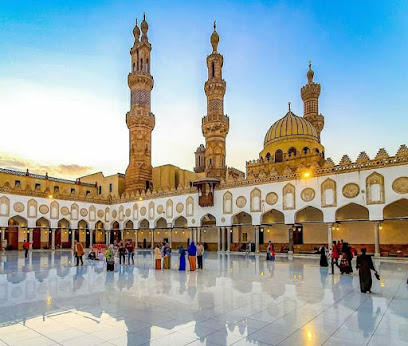
Al-Azhar Mosque: The Heart of Historic Cairo
Al-Azhar Mosque stands in the historic Islamic centre of Cairo, where religious monuments, traditional streets and commercial quarters preserve the character of the medieval city. It is both an active congregational mosque and the birthplace of a scholarly tradition that became influential across the Muslim world. Its importance cannot be understood through architecture alone: worship, teaching and the exchange of ideas have shaped the site for more than a millennium. The building also reflects successive periods of Egyptian history, making it a particularly valuable place for understanding how Islamic Cairo developed.
Foundation Under the Fatimid Caliphate
The Fatimid commander Jawhar al-Siqilli founded Cairo in 969 CE for Caliph al-Muizz li-Din Allah. Construction of Al-Azhar began on 4 April 970 CE, corresponding to 24 Jumada al-Ula 359 AH, according to Al-Azhar's official history. The first Friday prayer was held on 21 June 972 CE, or 7 Ramadan 361 AH. The mosque served the new Fatimid capital as its first congregational mosque and provided a setting for religious teaching. It is also regarded by Al-Azhar as the oldest surviving Fatimid monument in Egypt.
The Meaning and Origin of the Name Al-Azhar
The name Al-Azhar has been interpreted in several ways, and its precise historical origin is not established beyond disagreement. The explanation favoured in Al-Azhar's official account connects the name with Fatima al-Zahra, the daughter of the Prophet Muhammad, through whom the Fatimid dynasty claimed descent. Other explanations associate the word with brightness and radiance. These interpretations form part of the mosque's historical identity, but the connection to Fatima should be understood as the leading explanation rather than an indisputably documented naming event.
From Fatimid Teaching to Sunni Scholarship
The mosque was initially a centre for teaching the Ismaili Shiite religious tradition associated with the Fatimid rulers. After Saladin brought Fatimid rule to an end in 1171, Friday congregational prayers at Al-Azhar were suspended, while other Sunni institutions received support. Friday prayer returned in 1267 during the Mamluk period. Al-Azhar subsequently emerged as an important centre for the study of Sunni Islam, including its major schools of jurisprudence. This transformation is central to the institution's history, illustrating changes in religious authority and education across medieval Egypt.
The Original Plan, Courtyard and Prayer Arcades
The early mosque was organized around an open courtyard with surrounding arcades. Cairo Governorate's architectural account describes an initial arrangement with three arcaded sides and a larger eastern qibla arcade, the principal prayer area facing toward Mecca. Columns, piers and repeated arches create the rhythmic spatial character associated with the mosque. The courtyard and adjoining prayer spaces have undergone major alterations and extensions, so the building seen today should not be treated as an unchanged tenth-century structure. Its layout is best understood as the accumulated work of many generations.
Fatimid Architecture and Kufic Ornament
Although later construction changed the original mosque considerably, early Fatimid artistic traditions remain essential to its identity. These include the architectural use of arcades, decorated surfaces and Kufic inscriptions. During the reign of the Fatimid Caliph al-Hafiz, additions were made to the courtyard and its surrounding architectural elements in the twelfth century. Cairo Governorate identifies an inscribed dome associated with this phase as a particularly important survival. Such details help distinguish the early architectural character of Al-Azhar from the later minarets and monumental entrances added under subsequent rulers.
Mamluk Minarets and Architectural Additions
The Mamluk period gave Al-Azhar some of its most recognizable features. Rulers and senior officials enlarged the mosque, supported teaching and added religious schools. Among the notable structures are the Taybarsiyya, Aqbughawiyya and Gawhariyya madrasas. Sultan Qaytbay contributed an important entrance and minaret, while Sultan Qansuh al-Ghuri commissioned the famous double-headed minaret in the early sixteenth century. Its paired upper turrets and elaborate stonework have become defining features of the mosque's skyline. These additions make Al-Azhar a visual record of changing architectural tastes.
Ottoman Expansion and Abd al-Rahman Katkhuda
Al-Azhar continued to develop after Egypt entered the Ottoman Empire. One of its most significant later expansions was undertaken by Abd al-Rahman Katkhuda in the eighteenth century, particularly around 1753. His works included additional prayer areas behind the earlier qibla space, new architectural features and entrances, and facilities serving worshippers and students. Rather than replacing the mosque's older historical layers completely, these extensions enlarged the functioning religious complex. They also demonstrate how patrons continued to invest in Al-Azhar long after the Fatimid and Mamluk eras.
The Riwaqs and Students from Across the Islamic World
For centuries, Al-Azhar's educational life was organized around study circles and residential areas known as riwaqs. Students from Egypt and other regions of the Muslim world studied and sometimes lived within this scholarly environment. Particular riwaqs were associated with communities such as those from the Levant, the Maghreb, Yemen, Sudan and parts of Asia. These spaces were more than classrooms: they supported daily life and helped connect scholars from different linguistic, geographical and legal traditions. The riwaq system remains an important part of Al-Azhar's institutional memory.
A Tradition of Religious and Intellectual Learning
Teaching at Al-Azhar historically included Qur'anic interpretation, hadith, jurisprudence, Arabic grammar and rhetoric, alongside subjects such as logic, mathematics and astronomy at different times. The older teaching system relied on scholarly circles, personal study and authorization from teachers rather than the organization of a modern university. Over the centuries this tradition evolved into the wider institution associated with Al-Azhar today. Modern Al-Azhar University developed through administrative and educational reforms, notably the legislation of 1961, and should be distinguished from the historic mosque building itself.
Al-Azhar Within the UNESCO-Listed Historic Cairo
Al-Azhar Mosque is a significant monument within Historic Cairo, which was inscribed on the UNESCO World Heritage List in 1979. UNESCO recognizes the wider city's outstanding historic urban fabric, religious buildings, architectural traditions and scholarly importance. Its assessment specifically identifies Al-Azhar as a major centre of theological and religious learning. The designation applies to the Historic Cairo property rather than representing a separate UNESCO inscription for the mosque. The surrounding streets, markets and monuments are therefore part of the broader cultural setting that gives Al-Azhar its meaning.
Visiting Al-Azhar Mosque Respectfully
A visit offers an opportunity to appreciate the mosque's architecture while recognizing that it remains an active place of worship. The courtyard, arcades and exterior minarets provide different perspectives on the building's long history. Visitors should dress modestly, respect prayer activities, follow instructions from mosque staff and remove footwear wherever required. Access to particular areas may be restricted during religious activities or maintenance, so arrangements should be confirmed locally. The nearby Khan el-Khalili area and other monuments of Historic Cairo provide additional context, but they should not be confused with the mosque's precise mapped location.
Conservation and a Living Heritage
Al-Azhar has been restored and modified repeatedly, reflecting both its continuing religious use and its value as a historical monument. Al-Azhar's official history records comprehensive restoration work completed in 2018. Conservation is especially important at a site where different architectural periods survive together and where daily use continues. The mosque's identity therefore rests on more than its earliest walls: it encompasses the Fatimid foundation, Mamluk and Ottoman patronage, generations of scholars and the living traditions maintained within Historic Cairo. Preserving these layers is essential to understanding its heritage.