
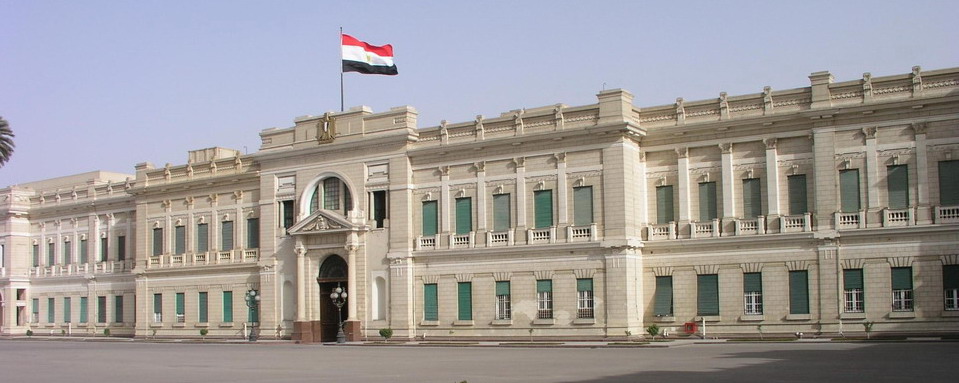
From Abdeen Bey’s Residence to a Khedival Palace
Abdeen Palace takes its name from Abdeen Bey, a military figure from the era of Muhammad Ali Pasha who owned a residence on the site of the present palace. When Khedive Ismail came to power in 1863, he chose this location for a new royal palace and acquired Abdeen Bey’s property from his widow. The earlier residence was demolished, and the surrounding land was progressively incorporated into the new palace estate.
Preparing the site required substantial changes to the area. Existing ponds were filled, the ground was levelled, and adjoining properties were purchased and removed as the palace grounds expanded. Official Egyptian sources give slightly different figures for the final estate—about 24 to 25 feddans—but agree that the project transformed the original residence and its surroundings into a much larger royal complex.
The new palace was not intended merely as another royal residence. Khedive Ismail sought to transfer the center of government from the Citadel, which had long served as Egypt’s seat of rule, to the heart of the developing modern city. Construction continued for roughly a decade; while the palace became the official seat of government during Ismail’s reign, work on its numerous rooms and interiors continued into the early 1870s, with the Cairo Governorate source stating that the rooms were not fully completed until 1874.
Khedive Ismail and the Creation of Modern Cairo
Abdeen Palace was conceived as part of Khedive Ismail’s broader transformation of Cairo, rather than as an isolated royal building. Official Egyptian sources describe his reign as a period of major urban expansion in which Cairo gained new districts planned with European architectural and urban influences. The Cairo Governorate identifies the Ismailia district—corresponding broadly to parts of present-day Abdeen and Downtown Cairo—and Faggala among the areas developed during this transformation.
The Egyptian Presidency places Abdeen Palace directly within this modernization program, describing the new Cairo envisioned under Ismail as a city of spacious squares, broad streets, palaces, buildings, Nile bridges, and landscaped gardens. The palace therefore formed both an architectural centerpiece and an administrative anchor for the developing modern city.
One of the most significant changes was political as well as urban. Ismail ordered Abdeen Palace after taking power in 1863 and intended it to replace the Citadel of Salah al-Din as the ruler’s principal seat in Cairo. Moving the center of government from the elevated medieval fortress to the newly developed urban center symbolized a major shift in the geography of Egyptian rule. Cairo Governorate records that Abdeen Palace subsequently functioned as the seat of government until 1952.
Abdeen Palace should therefore be understood within the larger story of Khedivial Cairo: a nineteenth-century attempt to reshape the capital through new streets, squares, districts, monumental buildings, and administrative institutions. Egyptian official sources characterize this program as laying important foundations for modern Cairo, with Abdeen Palace occupying a central place in that transformation.
Designing and Building Abdeen Palace
Khedive Ismail ordered the construction of Abdeen Palace after assuming power in 1863. Before the new palace could rise, the site had to be substantially reshaped: several ponds were filled, the ground was levelled, neighboring buildings were acquired and demolished, and additional properties were purchased over several years. Official records cited by the Egyptian Presidency place the resulting palace estate at approximately 24–25 feddans.
The Egyptian Presidency describes Abdeen as a French Neoclassical palace designed by a team working under the supervision of the French architect Léon Rousseau. Egyptian, French, Italian, English, and Turkish architects, engineers, artists, and craftsmen participated in the project; the Presidency also identifies De Corel among the notable engineers involved. Cairo Governorate likewise emphasizes the palace's European architectural character and identifies Rousseau in connection with its design.
The project was ambitious in both scale and timetable. Khedive Ismail sought to have the palace ready in connection with the international celebrations surrounding the opening of the Suez Canal in November 1869, but the building was still incomplete at that time. The Egyptian Presidency notes that Empress Eugénie of France therefore stayed elsewhere during her visit to Egypt.
Official Egyptian sources give slightly different dates and room totals for the palace's final completion. The Presidency states that Abdeen became the official royal seat from its opening in 1872 and records approximately 550 rooms and halls, excluding corridors. Cairo Governorate states that construction took about ten years and that the palace's approximately 500 rooms were not fully completed until 1874. Rather than representing a single precisely documented completion date, these accounts indicate that the palace entered use while work on its extensive interiors was still being finished.
The resulting complex was deliberately different from the fortified character of the Citadel. Its European-inspired palace architecture, ceremonial spaces, reception halls, residential wings, courtyards, and multiple entrances were designed for a nineteenth-century royal court and for the governmental functions that Ismail was transferring into the center of modern Cairo.
Architecture, Decoration, and the Palace Interiors
Abdeen Palace was designed principally in the French Neoclassical style, under the supervision of the French architect Léon Rousseau, with contributions from architects, engineers, artists, and craftsmen from Egypt, France, Italy, England, and Turkey. This international participation is reflected in interiors that combine European palace design with Arab and Islamic decorative elements.
The palace consists of two main floors linked by courtyards and served by several entrances. Its upper level was divided principally between the Salamlik, used for receptions, ceremonies, and official functions, and the Haremlik, which contained the private residential quarters. The ground floor accommodated service and administrative functions, including guard rooms, ceremonial offices, storage areas, and servants’ quarters. Kitchens were housed separately to reduce the risks of fire and cooking odors within the principal palace.
The interiors were conceived on a scale appropriate to a royal court. Official descriptions record floors of colored marble and alabaster, while doors and windows incorporated colored glass decorated with images including vegetation, seascapes, birds, and figurative motifs. Ceilings feature geometric and gilded relief decoration drawing on Arab, Islamic, and Italian influences, and monumental staircases were traditionally covered with red carpets.
Different ceremonial rooms were given their own visual identities. Cairo Governorate records salons associated with white, red, and green decorative schemes, created for receiving official delegations. The palace also preserves Italian, Turkish, and French decorative influences, rare paintings, and furniture embellished with gilded and handcrafted ornament.
Among the palace’s major interiors is the Muhammad Ali Hall, described by Cairo Governorate as its largest and most sumptuous hall. Unlike the predominantly European character of much of the palace, this space was executed in an Arab-Islamic style, with intricate ornament incorporating marble, granite, and amber. The palace therefore does not represent a single decorative vocabulary; rather, its interiors document the mixture of European court architecture and regional artistic traditions favored by Egypt’s nineteenth- and early twentieth-century royal establishment.
The exterior entrances also formed part of the palace’s ceremonial presentation. The Egyptian Presidency identifies Bab Paris (Paris Gate) on the eastern side as one of the principal entrances and records a wrought-iron gate on the main façade bearing the initial of Khedive Ismail’s name in gilded decoration.
The Salamlik, Haremlik, Throne Hall, and Royal Apartments
The upper floor of Abdeen Palace was organized around two principal divisions: the Salamlik and the Haremlik. The Salamlik functioned as the palace’s public and ceremonial wing, accommodating receptions, official meetings, state occasions, and formal entertainment. According to the Egyptian Presidency, it included the Suez Canal Hall, colored salons, meeting hall, winter garden, Muhammad Ali Hall, principal dining room, royal theatre, throne hall, and Khedive Ismail Salon.
The Haremlik formed the private residential section used by the royal household. Official descriptions identify residential apartments, the Byzantine Hall, Belgian Suite, and a smaller dining room among its principal spaces. The distinction between the two wings therefore reflected function: the Salamlik represented the formal face of the monarchy, while the Haremlik provided more private accommodation for the royal family and household.
One of the most important ceremonial spaces was the Throne Hall. The Egyptian Presidency describes it as a spacious hall incorporating an Arab-style room with parquet flooring. A door separated the throne area from the Haremlik, where access was restricted, illustrating the controlled transition between the palace’s official and private zones.
From the throne area, a long corridor led toward the king’s private suite. Official documentation records that this suite contained an office, salon, bedroom, and bathroom. It was associated with adjoining royal accommodation, including suites for the Queen of Egypt and Queen Nazli, demonstrating how ceremonial state spaces and private royal apartments were physically connected while remaining functionally distinct.
The palace did not remain architecturally static. During the reign of King Fuad I, additional work was undertaken under the Italian architect Antonio Lasciac Ferrucci, commonly identified in official Egyptian material as Ferrucci. The Salamlik was enlarged, another throne hall was added, and a suite was created for Queen Nazli. Between 1926 and 1930, Ferrucci also designed the richly decorated Byzantine Hall, one of the important later additions to Abdeen’s royal interiors.
These interconnected spaces show how Abdeen Palace operated simultaneously as a residence and the center of royal government. Its internal plan separated ceremonial representation, administration, formal hospitality, and family life, while corridors and controlled entrances linked these different spheres within a single palace complex.
The Belgian Pavilion, Palace Library, and Theatre
Beyond its throne rooms and residential apartments, Abdeen Palace contains several spaces that reveal how it functioned as both a royal residence and a center for official hospitality. Among the most distinctive is the Belgian Pavilion, located within the Haremlik section. According to the Egyptian Presidency and Cairo Governorate, it received its name because the King of Belgium was the first royal guest to stay there. Official descriptions emphasize the pavilion’s elaborate architectural and decorative treatment and note an unusually ornate bed decorated with finely executed handmade motifs.
The palace also possesses a substantial library. The Egyptian Presidency describes its holdings as numbering in the thousands and including rare Arabic and English books covering subjects such as history, politics, and military affairs. Significantly, the palace library also preserves records associated with the Egyptian parliament from its early sessions during the reign of Khedive Ismail, giving the collection documentary as well as bibliographical importance.
A further component of the Salamlik was the royal theatre. It was intended for performances presented before members of the royal household, distinguished guests, and official delegations. The Presidency specifically records its gilded seating, reflecting the ceremonial character of the space and its role in court entertainment and state hospitality. The theatre appears in the official listing of the principal rooms of the Salamlik alongside spaces such as the Suez Canal Hall, Muhammad Ali Hall, dining room, throne hall, and Khedive Ismail Salon.
Together, the Belgian Pavilion, library, and theatre illustrate three different dimensions of life at Abdeen: accommodation for prominent foreign visitors, the preservation of knowledge and official records, and ceremonial entertainment. They demonstrate that the palace was designed not simply as a ruler’s residence but as a complex institution serving the diplomatic, cultural, administrative, and social functions of the Egyptian court.
Abdeen Palace as the Seat of Government
Abdeen Palace marked a major change in the physical center of political authority in nineteenth-century Egypt. Khedive Ismail commissioned the palace after assuming power in 1863 with the intention of transferring the ruler’s principal residence and governmental center from the Citadel of Salah al-Din to the developing heart of Cairo. Cairo Governorate describes this as the first major relocation of the ruler’s seat away from the Citadel since the medieval period.
Once brought into official use, Abdeen became the principal palace of the rulers of the Muhammad Ali dynasty and the main headquarters of royal government. The Egyptian Presidency dates its formal role as the seat of government from the palace’s opening in 1872 until 1952. Other official Cairo Governorate pages give 1873 or 1874 as the starting date, reflecting differences between the palace’s opening, occupation, and completion of its extensive construction and interiors. All of these official accounts agree that Abdeen remained a central seat and symbol of royal authority until the end of the monarchy in 1952.
Its role went far beyond providing accommodation for the ruling family. The palace contained the throne hall, reception rooms, meeting spaces, ceremonial halls, administrative areas, royal offices, and residential apartments, allowing political administration, court ceremonial, diplomatic hospitality, and royal life to operate within the same complex. The Salamlik in particular contained spaces devoted to official receptions, meetings, state ceremonies, and audiences.
Because Abdeen functioned at the center of government for roughly eight decades, the palace also became the setting for several defining episodes in modern Egyptian political history. These included the military demonstration led by Ahmed Urabi in 1881, the confrontation between King Farouk and British forces on 4 February 1942, and the events surrounding the overthrow of the monarchy during the July 1952 Revolution. Each of these episodes connected the palace physically and symbolically with struggles over political authority in Egypt.
After the monarchy ended, Abdeen ceased to function as the principal royal seat. It became one of Egypt’s presidential palaces, and the Egyptian Presidency records that President Anwar Sadat later used it as a presidential seat of government. Its continued official use, alongside its museums and preserved royal interiors, means that Abdeen represents successive phases of Egyptian state history rather than only the period of the monarchy.
The Urabi Demonstration of 1881
On 9 September 1881, Abdeen Palace became the setting for one of the defining confrontations of nineteenth-century Egyptian political history. Egyptian army officer Ahmed Urabi (ʿUrabi) led troops to the square in front of the palace to present demands to Khedive Tawfiq. The Egyptian Presidency records the event as the demonstration at which Urabi presented the demands of the Egyptian army and nation directly to the Khedive.
The confrontation had developed from growing dissatisfaction within the army and a broader constitutional and political opposition. Egyptian officers objected to conditions within the military, while wider political groups sought greater representative government. Modern scholarship emphasizes that the movement eventually extended beyond a purely military dispute and attracted civilian and landed-notable participation. Historians consequently differ in terminology: the event is variously discussed as part of the Urabi Movement, Urabi Revolt, or Urabi Revolution.
At Abdeen, the principal demands presented to Tawfiq were the dismissal of the government headed by Riyad Pasha, the restoration or establishment of representative parliamentary government, and an increase in the size of the Egyptian army. The official Sharqia Governorate account records these three demands, while historical research specifies that the proposed army strength was 18,000 men, in accordance with an earlier Ottoman authorization.
The demonstration produced an immediate political result. Riyad Pasha’s ministry was dismissed, and the constitutionalist Sherif Pasha was subsequently called upon to form a government. The representative chamber was reconvened in the political developments that followed. The Cambridge History of Egypt treats the Abdeen demonstration as the event that initiated the revolutionary phase of the Urabi movement and notes that the army’s action had prior support from influential landed notables.
The importance of the event therefore reaches beyond the image of soldiers assembled outside a royal palace. Abdeen was Egypt’s principal seat of government, and the demonstration transformed its forecourt into the setting for a direct challenge over the distribution of political and military authority. The crisis continued through 1881–1882, amid disputes over constitutional government, European influence, and control of the state, ultimately culminating in British military intervention and occupation in 1882.
For Abdeen Palace itself, 9 September 1881 became one of the landmark events in its history. The Egyptian Presidency specifically includes the Urabi demonstration among the major historical episodes witnessed by the palace, alongside the 1942 Abdeen Palace crisis and the events of 1952.
The Abdeen Palace Crisis of 4 February 1942
On 4 February 1942, during the Second World War, Abdeen Palace became the center of a dramatic confrontation between King Farouk and Britain, whose forces maintained a major military presence in Egypt. The Egyptian Presidency records that British armored forces surrounded the palace in an attempt to compel the king to entrust Mustafa al-Nahhas Pasha, leader of the Wafd Party, with forming a government. Contemporary diplomatic records confirm that British troops were mobilized around the palace that evening.
The confrontation developed amid a political crisis over the composition of Egypt’s government. On 3 February, British ambassador Sir Miles Lampson had told the palace that Britain wanted a government capable of implementing the Anglo-Egyptian alliance obligations and maintaining internal stability during the war. He argued that such a government required consultation with Nahhas. The following day, King Farouk discussed possible arrangements with Egyptian political leaders, while Nahhas maintained that he would take responsibility only if allowed to form a Wafd government rather than a broader coalition.
According to a contemporary U.S. diplomatic telegram, Farouk reported receiving what he described as an ultimatum at about 3 p.m. on 4 February: unless Nahhas was charged with forming a cabinet by 6 p.m., the king would face unspecified consequences whose seriousness was understood. Egyptian political figures consulted by the king objected to the British intervention, and Nahhas initially indicated that he would not form a ministry under those circumstances.
The crisis reached its climax that night. British troops surrounded Abdeen Palace, and at approximately 9 p.m. Lampson entered the palace accompanied by the senior British military commander in Egypt and an armed escort. A U.S. diplomatic report written that same evening states that Lampson brought a prepared abdication document for the king to sign if he refused the British demand. Farouk did not abdicate; instead, he summoned Nahhas and charged him with forming a new government.
Nahhas subsequently formed a Wafd government. Contemporary diplomatic reporting also records protests by senior Egyptian parliamentary figures against Britain’s intervention in the country’s internal political affairs. Historical scholarship regards the episode as having important consequences for the reputations of the monarchy, Britain, and the Wafd. Interpretations differ over the longer-term political effects, but the coercive nature of the palace confrontation itself is well documented in contemporary diplomatic records.
For the history of Abdeen Palace, the event demonstrated the building’s importance as more than a royal residence. Because it was the principal seat of the monarchy and government, the surrounding of the palace placed a dispute over Egyptian governmental authority directly at its gates. The Egyptian Presidency consequently lists 4 February 1942 among the major political events witnessed by Abdeen Palace.
From Monarchy to Presidential Palace
The July Revolution of 1952 ended Abdeen Palace’s long role as the principal seat of Egypt’s monarchy. The Egyptian Presidency records that, during the first hours of the revolution, forces associated with the Free Officers surrounded the palace. Abdeen had served as the main headquarters of royal government from 1872 until 1952, linking the building closely with the final decades of the Muhammad Ali dynasty.
The political system changed rapidly after the revolution. King Farouk abdicated in July 1952, and the monarchy itself was formally abolished when Egypt was declared a republic in 1953. Abdeen therefore ceased to be the principal royal seat for which it had originally been built. Presidential functions in the republican period were not immediately concentrated there: the Egyptian Presidency records that Qubba Palace became an official presidential palace after the 1952 Revolution, where President Gamal Abdel Nasser received official foreign visitors.
Abdeen nevertheless remained part of the state’s palace system. The Presidency specifically records that President Mohamed Anwar Sadat later adopted Abdeen Palace as a presidential seat of government. This gave the nineteenth-century royal palace a new institutional role under the republic while preserving its connection with the highest levels of Egyptian government.
The transition did not erase the palace’s royal heritage. Parts of Abdeen had already been developed for museum display from the reign of King Fuad I, and the palace subsequently retained important collections of arms, silverware, decorations and medals, historical documents, and official gifts. In the republican era these collections became part of the palace’s broader historical and museum function. The Presidency has also designated space at Abdeen for the Museum of the President’s Gifts, extending the collections into the presidential period.
Abdeen continues to serve official as well as historical functions. For example, in April 2016, President Abdel Fattah El-Sisi received Saudi King Salman bin Abdulaziz at Abdeen Palace; the two leaders toured the historic building, attended an official dinner and performance there, and witnessed the signing of agreements. This documented use illustrates how Abdeen today combines the identities of historic royal palace, museum complex, and venue for presidential ceremonies and state hospitality.
How the Palace Museums Developed
The museums of Abdeen Palace did not emerge at a single moment. Their development began during the monarchy as members of the ruling family accumulated and displayed valuable objects inside the palace. Cairo Governorate states that the descendants of Khedive Ismail allocated several palace halls for collections acquired in Egypt and abroad, gradually giving Abdeen the character of a museum complex as well as a functioning royal palace.
The Egyptian Presidency identifies the reign of King Fuad I as the decisive stage in this transformation. During his reign, museum spaces were formally created within Abdeen for the display of historical objects, including arms, medals and decorations, rare artifacts, and official gifts. This development formed part of a wider program of alterations to the palace under Fuad, which also included extensions to the Salamlik and the creation of new ceremonial and residential spaces.
The collections continued to develop under King Farouk. Cairo Governorate specifically attributes the establishment of the palace’s War or Arms Museum to Farouk and records that its displays included weapons associated with the king as well as other light arms. Over time, the palace collections came to encompass arms and ammunition, royal possessions, decorations and medals, precious tableware, documents, and gifts, reflecting both the private collecting interests of the royal family and the ceremonial activities of the Egyptian state.
A major modern phase came in 1998. The Egyptian Presidency states that the Abdeen museums were opened to the public on 17 October 1998 after additional museum sections had been prepared for presidential gifts, historical documents, silverware, and the Royal Hunting Hall. The visitor entrance was organized through Paris Gate, with the museums connected by a route through the palace grounds. Cairo Governorate independently describes the modern complex as several museums linked by a single visitor itinerary through the gardens.
Official sources provide additional dates for individual collections. Cairo Governorate states that the Silverware Museum was added in 1998, preserving objects of gold, silver, crystal, and colored glass associated with the Muhammad Ali dynasty. It dates the opening of the Historical Documents Museum to 2004, describing it as one of the newest museums in the palace and noting that its holdings extend from the era of Muhammad Ali Pasha to that of King Farouk.
The history of the presidential-gifts displays is more complex because official sources describe more than one phase. Cairo Governorate records a Presidential Gifts Museum established in 2005 during President Hosni Mubarak’s period, while the current Egyptian Presidency documents a later initiative in which President Abdel Fattah El-Sisi designated a hall at Abdeen as the Museum of the President’s Gifts, containing gifts he received after assuming office. These records indicate that the presentation of presidential gifts at Abdeen has been reorganized and expanded over time rather than representing a single unchanged museum installation.
Today, the Egyptian Presidency officially identifies the principal Abdeen museum collections as the Arms Museum, Medals and Decorations Museum, Silverware Museum, Presidential Gifts Museum, and Historical Documents Museum. Their development across the royal and republican periods is central to Abdeen’s present identity: the palace preserves not only its nineteenth-century architecture but also objects documenting Egypt’s monarchy, state ceremonial, military history, diplomacy, and presidency.
The Arms, Ammunition, Medals, and Decorations Collections
The military collections are among the oldest formally organized museums at Abdeen Palace. The Egyptian Presidency states that palace museums were established during the reign of King Fuad I in 1928, initially comprising two arms museums and a museum of medals and decorations. Their objects entered the palace through royal collecting, purchases at international auctions, official gifts, and inheritances associated particularly with the periods of King Fuad I and King Farouk.
The Arms and Ammunition Museum preserves weapons from different periods and regions and is divided into major groups of edged weapons and firearms. Cairo Governorate describes the edged-weapons collection as including swords, daggers, hunting implements, armor, shields, helmets, and fencing swords produced by craftsmen in the Islamic world and Europe. Many are valuable not only as weapons but also as examples of decorative craftsmanship, with hilts or scabbards incorporating gold, silver, ivory, diamonds, rubies, emeralds, coral, and other materials.
Among the pieces specifically identified by Cairo Governorate are a sixteenth-century sword attributed to Ottoman Sultan Selim I, swords and daggers associated with Muhammad Ali Pasha, a sword identified in the museum as belonging to Napoleon Bonaparte, and a dagger associated with German commander Erwin Rommel. These attributions are part of the official museum description and help illustrate the chronological and geographical range represented in the collection.
The firearms section contains weapons displaying different firing mechanisms, manufacturing traditions, and decorative techniques. Its displays include concealed or disguised firearms incorporated into walking sticks, pistols, rifles, and early matchlock weapons, with examples dating from the seventeenth, eighteenth, and nineteenth centuries. The official Cairo description notes decoration through gemstone inlay and the application of gold and silver, including hunting scenes worked into weapon components. It also identifies firearms bearing the name of Muhammad Ali and others associated by the museum with Napoleon Bonaparte.
The museum route extends into an open Artillery Court, where different types of cannon are displayed. Cairo Governorate records that some were manufactured in Egypt during the reign of Muhammad Ali Pasha and his successors in the nineteenth century. The display includes mortars as well as fortress and field artillery, adding heavy weapons to a collection otherwise dominated by portable arms.
A separate Museum of Medals and Decorations preserves royal possessions alongside decorations, orders, and medals. One notable object identified in the official description is a richly decorated sword known as the “Coronation Sword,” said to have been associated with Russian imperial coronations, made in Germany, and purchased by King Farouk at an international auction. Another documented object is an ammunition belt made of leather with worked gold, presented by King Abdulaziz Al Saud to King Farouk.
The medals and decorations themselves have a much wider international scope. Cairo Governorate states that examples were produced in Egypt, Europe, Asia, Africa, and the Americas. Such honors historically served several functions: recognizing distinguished service to the state and being presented to monarchs, presidents, and other prominent figures in diplomatic and official contexts. Together with the weapons collections, they preserve material evidence of royal collecting, military history, ceremonial culture, and Egypt’s international relations during the nineteenth and twentieth centuries.
Presidential Gifts and the Continuing Museum Collection
Abdeen Palace’s museum collections did not stop developing with the end of the monarchy. In the republican period, presidential gifts and possessions became another layer of the palace’s historical record, extending its collections from royal Egypt into the history of the modern Egyptian presidency. Official Egyptian sources document more than one phase in the organization of these displays.
Cairo Governorate records that a Presidential Gifts Museum was established in 2005 during the presidency of Hosni Mubarak. Its displays included a selection of presidential gifts, belongings associated with the Mubarak family, and royal honorary medals. This created a museum section specifically concerned with material connected to the republican presidency alongside Abdeen’s older royal collections.
A later initiative created what the Egyptian Presidency currently calls the Museum of the President’s Gifts. According to the Presidency, President Abdel Fattah El-Sisi designated one of Abdeen Palace’s halls for this purpose, and the collection contains the gifts he has received since assuming office. The Presidency presents these objects as official or protocol gifts preserved within a public institutional collection rather than as personal possessions.
An example of how such gifts enter the Abdeen collections was documented in 2014, when the Presidency announced that Russian President Vladimir Putin had presented President El-Sisi with an antiquity-related object during an official visit. The Egyptian president directed that the gift be deposited in the Abdeen Palace museums, with its provenance as a gift from the Russian president recorded.
These presidential collections continue a much older pattern at Abdeen. From the reign of King Fuad I, the palace contained exhibition rooms for artifacts, arms, medals, decorations, and official gifts acquired through purchase, inheritance, or diplomatic exchange. Gifts exchanged at the highest levels of state therefore form a recurring category within the palace collections across both the royal and republican periods.
The current Egyptian Presidency lists the Presidential Gifts Museum alongside the Arms Museum, Medals and Decorations Museum, Silverware Museum, and Historical Documents Museum among the principal museums housed within Abdeen Palace. Because official sources describe distinct presidential-gifts installations from different periods, the collection is best understood as one that has been reorganized and expanded over time, rather than as a single unchanged museum established on one date.
In this way, Abdeen’s museum holdings remain connected to the continuing history of the Egyptian state. Royal weapons, decorations, tableware, and documents preserve earlier phases of government, while presidential gifts add material evidence of later state protocol and international diplomatic exchange. Together, they allow the museum complex to document successive periods of Egyptian political and ceremonial history through the objects preserved within the palace.
Visiting the Abdeen Palace Museum Complex
Abdeen Palace Museum is located in Abdeen Square in central Cairo. The Cairo Governorate identifies the museum complex as being housed within the palace itself, while the Egyptian Presidency records that the museums were formally opened to the public on 17 October 1998.
The official visitor route is historically associated with Paris Gate (Bab Paris). The Egyptian Presidency states that this entrance, originally one of the Haremlik entrances, was designated as the principal gateway leading to the Abdeen Palace museums when the complex was opened to visitors.
A museum visit focuses on the collections preserved within the palace complex rather than implying unrestricted access to every historic royal apartment or ceremonial room. The officially documented museums include collections devoted to arms and ammunition, medals and decorations, silverware, historical documents, royal possessions, and presidential gifts. Cairo Governorate describes the museums as interconnected within the palace grounds, enabling visitors to encounter several different aspects of Egypt’s royal, military, diplomatic, and modern political history in one location.
Because Abdeen remains a presidential palace as well as a historic museum complex, access to particular areas differs from the experience of visiting a conventional standalone museum. The public museum experience centers on the collections and designated museum areas within the palace complex rather than representing a complete tour of every historic royal or official space.
For visitors, Abdeen offers a different perspective from Cairo’s ancient monuments. Its collections concentrate on the period of the Muhammad Ali dynasty and the modern Egyptian state, while the palace itself preserves the setting in which royal government, diplomatic ceremony, major political events, and later presidential functions unfolded. The value of the visit therefore lies not only in individual objects but also in encountering those collections within one of the principal historic centers of government in modern Cairo.