
A Palace on the Nile in Zamalek
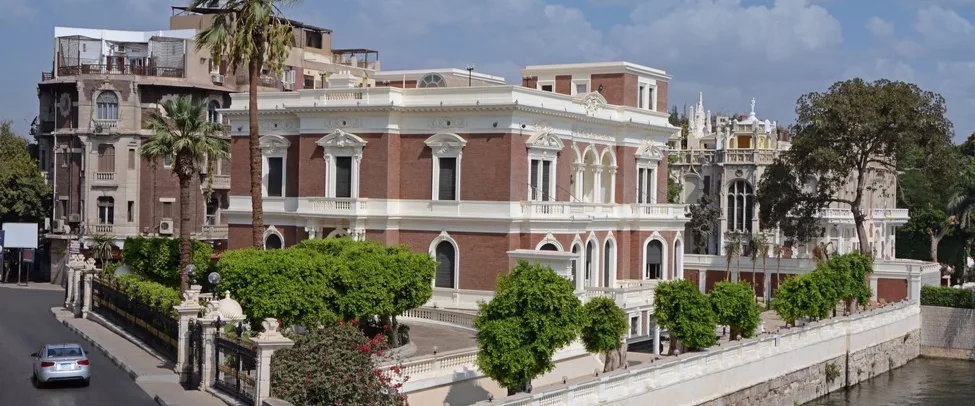
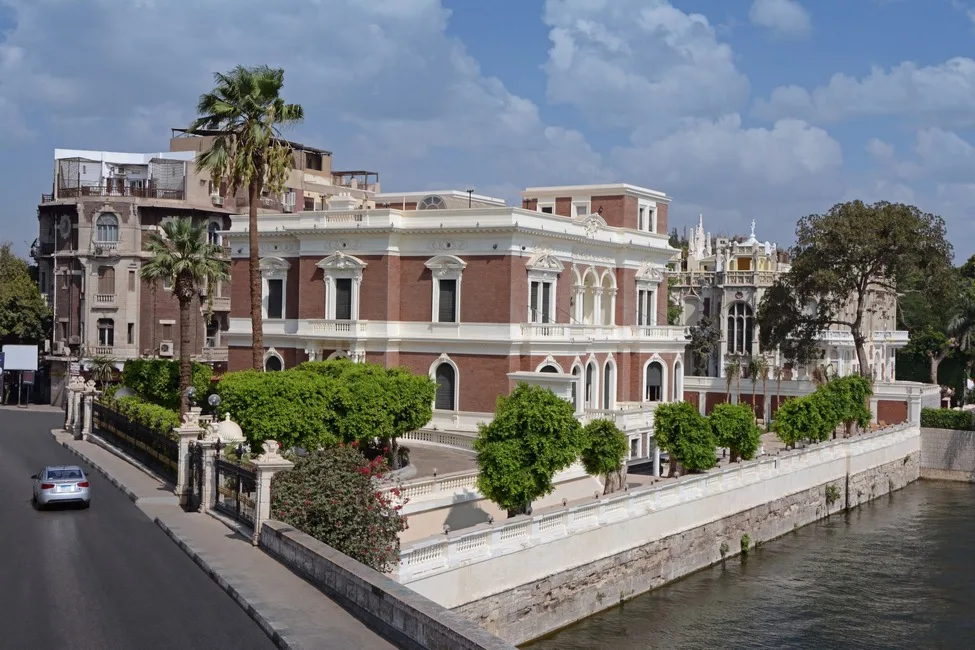
Aisha Fahmy Palace stands on the Nile side of Zamalek, one of Cairo’s most distinctive island districts. Egyptian official sources describe the palace as one of Zamalek’s important historic landmarks and date its construction to 1907. Designed by Italian architect Antonio Lasciac, the building occupies about 2,700 square metres and combines the character of an early twentieth-century private palace with its later role as a public cultural institution.
Its significance is therefore not limited to its riverside setting or historic architecture. After becoming associated with Egypt’s Ministry of Culture, the palace developed into the Arts Complex (مجمع الفنون), establishing a second identity as an important venue for visual-art exhibitions and cultural activity. Fine Arts Sector material describes it as a major platform in Egypt’s modern artistic life, while official records continue to identify the historic palace itself as an integral part of that cultural role.
The Palace’s Origins in 1907
Official Egyptian sources consistently date the construction of Aisha Fahmy Palace to 1907, but they differ slightly in how they describe its original ownership. The State Information Service says the palace was built by Fahmy Bey, son of Ali Pasha Fahmy, for his daughter Aisha and was called Qasr al-Khuld (Palace of Eternity). The Fine Arts Sector, meanwhile, describes the building as having been constructed in 1907 as a palace for Ali Pasha Fahmy. Both official accounts associate the palace with the Fahmy family and identify Antonio Lasciac as its Italian architect.
A separate Fine Arts Sector account published for the palace’s 2017 reopening states that Ali Pasha Fahmy, chief aide-de-camp to King Fuad, built the palace for his daughter Aisha Fahmy, again dating the building to 1907 and referring to it as Qasr al-Khuld. Because the official sources are not completely uniform on whether Ali Pasha Fahmy himself or another Fahmy family member should be named as the direct builder, the safest verified conclusion is that the palace was commissioned within the Fahmy family for Aisha Fahmy and completed in 1907.
Antonio Lasciac and the Palace’s Architectural Character
Aisha Fahmy Palace was designed by the Italian architect Antonio Lasciac, whose work formed part of Cairo’s late nineteenth- and early twentieth-century architectural landscape. Official Egyptian sources identify Lasciac as the palace’s designer and describe the building as European in character.
Architecturally, the palace combines a formal European exterior with richly varied interiors. A recent academic study of the building describes its exterior as Italian Renaissance in style, while noting that the interiors incorporate several traditions, including Renaissance Italian, French, Neoclassical, and Japanese influences. The result is not a single uniform decorative scheme, but a sequence of spaces whose finishes and ornament reflect different European and international tastes.
The palace’s architectural identity is reinforced by elements such as stained-glass windows, decorative woodwork, sculptural details, ornate stair elements, textiles, and European ornament. These surviving features are a major part of the building’s heritage value and help explain why later restoration projects treated both the structure and its interior decoration as significant components of the site.
Aisha Fahmy and the Palace That Took Her Name
The palace is permanently associated with Aisha Fahmy, a member of the Fahmy family whose name eventually became the building’s public identity. Official Egyptian sources agree that she lived in the palace for many years, although they are not completely consistent about the precise details of its original commissioning and ownership. The State Information Service states that the palace was built for Aisha in 1907, while Fine Arts Sector material also links its construction to her father, Ali Pasha Fahmy, who served in the royal court of King Fuad I.
A Fine Arts Sector publication adds an important later detail: after an earlier period in which the palace was occupied by Ali Bey Fahmy and his French wife, Aisha Fahmy acquired the family shares in the palace inheritance and lived there until 1958, when ownership passed to the Ministry of Culture. Because official accounts differ on some earlier family details, those points should be treated cautiously; what is well supported is that Aisha Fahmy became the palace’s long-term resident and the figure with whom the building is now most closely identified.
Inside the Palace: Rooms, Decoration, and Materials
Aisha Fahmy Palace is arranged over two floors, and its interiors preserve much of the decorative character that distinguishes the building from a conventional exhibition venue. The State Information Service notes that the first floor contains rooms used for displaying visual art, while the second floor includes several historic rooms associated with the palace’s original residential function.
Among the surviving interior features are wall panels and textiles made from silk and linen, together with European-style decorative work along the walls. The upper floor also preserves spaces connected with Aisha Fahmy’s private life, including her dressing room and a bathroom fitted with a gas-powered water heater—an unusually advanced domestic feature for the period, according to the official description.
The palace’s later conversion into the Arts Complex adapted these historic interiors for cultural use rather than erasing their identity. The Fine Arts Sector records that the complex contains seven exhibition halls, traditionally named “Akhenaten,” which have hosted exhibitions and cultural events since the 1970s. This combination of preserved historic rooms and dedicated gallery spaces is central to the building’s present character.
The Japanese Room and Its Distinctive Design
Among the most distinctive historic interiors in Aisha Fahmy Palace is the Japanese Room on the second floor. The Egyptian State Information Service confirms that the room was presented to Aisha Fahmy and designed specifically for her. Its walls incorporate Japanese words and images, while the room also contains two gold-colored statues.
The room stands apart from the palace’s predominantly European decorative character and illustrates the variety of artistic influences preserved inside the building. A contemporary account of the restored palace similarly describes the room as Japanese in design and records two gilded wooden Buddha figures among its decorative features.
Some secondary sources go further and state that the room was a gift from the Japanese embassy or ambassador, but the official State Information Service page does not identify the donor. For that reason, the securely verified description is that the Japanese Room was gifted to Aisha Fahmy and specially designed for her; the identity of the donor should be treated as less certain.
From Private Residence to Ministry of Culture Property
Aisha Fahmy Palace remained a private residence until 1958, when its ownership passed to Egypt’s Ministry of Culture. An official Fine Arts Sector publication states that the ministry purchased the palace that year and used it as its first headquarters during the tenure of Tharwat Okasha, Egypt’s first minister of culture.
The building’s institutional role continued to evolve. In 1975, Culture Minister Youssef El-Sebai approved the palace’s transfer to the General Authority for Arts and Letters, the body associated with what later became the Fine Arts Sector. Official Fine Arts Sector material states that the palace subsequently became the Arts Complex, with its cultural role beginning in this form in the mid-1970s.
The palace also briefly received another proposed museum function. The State Information Service records that a 1978 presidential decree allocated it as a museum for the jewellery of the Muhammad Ali dynasty, but that decision was later cancelled in 1986, after the Royal Jewellery Museum was assigned to Fatma Haider Palace in Alexandria. The Zamalek palace then returned to Ministry of Culture use as an arts complex.
The Birth of the Arts Complex
The transformation of Aisha Fahmy Palace into the Arts Complex began in 1975, when artist and cultural administrator Abdel-Hamid Hamdy, then head of the General Authority for Arts and Literature, secured approval from Culture Minister Youssef El-Sebai to return the palace to the arts authority. Hamdy gave the palace the name “Arts Complex” (Mogamma El-Fonoun), and the Fine Arts Sector describes it as the first arts complex of its kind in Egypt.
The palace’s internal exhibition halls were given the name “Akhenaten.” Official Fine Arts Sector material states that the complex contains seven exhibition halls under this name, and that its sustained cultural activity began in October 1976. From that point, the complex hosted exhibitions, seminars, musical performances, and film screenings, broadening the palace’s role far beyond that of a preserved historic residence.
This change established a new chapter in the building’s history: a private palace became a public cultural venue devoted primarily to visual art and related cultural activities. Fine Arts Sector publications describe this transition as the moment when the palace began to function as a major platform for modern and contemporary artistic activity in Cairo.
A Platform for Egypt’s Modern Visual-Arts Movement
From the late 1970s onward, the Arts Complex at Aisha Fahmy Palace became one of Cairo’s major venues for visual-art exhibitions and cultural programs. The Fine Arts Sector states that the complex hosted hundreds of exhibitions, seminars, concerts, and film screenings, including exhibitions featuring internationally known artists such as Salvador Dalí, Henry Moore, Pablo Picasso, Giorgio de Chirico, and David Hockney.
The palace also played an important institutional role in Egypt’s organized art scene. The National Art Exhibition was held there from 1976 to 1988, while the complex also shared in major events including the Cairo International Biennale, the International Ceramics Biennale, the Egyptian International Print Triennale, and the Youth Salon. These activities linked the palace not only with individual exhibitions but with broader national and international art programs.
Fine Arts Sector publications describe Aisha Fahmy Palace as one of the important platforms from which significant artistic projects and experiments emerged in Egypt’s modern visual-arts movement. Its role has continued after restoration, with later exhibitions bringing historic Egyptian works, museum collections, and contemporary artistic interpretations into the palace’s galleries.
Restoration and the 2017 Reopening
Aisha Fahmy Palace stopped operating as the Arts Complex in 2005, when it entered a long restoration and development program supervised by Egypt’s Fine Arts Sector, with support from the Cultural Development Fund and coordination with the Islamic and Coptic Antiquities sector. Official sources state that the project aimed to recover the palace’s architectural and decorative character while preparing the building for renewed cultural use.
The restoration was extensive rather than cosmetic. Fine Arts Sector documentation records structural interventions inside the palace, including reinforcement of the basement ceiling, treatment of cracks, repairs to concrete slabs and beams, protection of reinforcement steel, and strengthening works designed to accommodate the loads expected from future visitors. The same documentation emphasizes that the structural work was carried out in a way intended to preserve the building’s architectural and decorative elements.
After approximately twelve years of restoration and development, the palace reopened as the Arts Complex on 17 May 2017. The reopening was accompanied by the exhibition “Treasures of Our Art Museums,” which brought together selected works from eleven museums affiliated with the Fine Arts Sector. The State Information Service notes that the palace had been closed for nearly fifteen years before its reopening and had already been registered as a historic building in 2010.
The Palace as an Exhibition Space Today
Aisha Fahmy Palace continues to function as a cultural and exhibition venue rather than solely as a preserved historic residence. The Fine Arts Sector describes the restored palace as a space equipped for changing art exhibitions, seminars, film screenings, workshops, and cultural gatherings, preserving its architectural character while adapting it for contemporary artistic use.
Its role has extended beyond conventional gallery exhibitions. In 2019, the palace was one of the official venues of the 13th Cairo International Biennale, alongside the Palace of Arts and the Egyptian Museum of Modern Art. This confirms its continuing integration into Egypt’s major institutional visual-arts programs after its 2017 reopening.
The palace has also been used for contemporary design programming. During Cairo Design Week 2025, Aisha Fahmy Palace hosted installations and exhibitions that placed contemporary furniture, design, glass, floral art, and other creative work within its historic interiors. This type of programming demonstrates how the building’s present identity combines heritage architecture with temporary exhibitions and contemporary creative practice.
Why Aisha Fahmy Palace Matters to Cairo’s Cultural Heritage
Aisha Fahmy Palace is significant because it brings together architectural heritage and an active cultural function within a single historic building. The Fine Arts Sector identifies the palace as one of Zamalek’s important landmarks and emphasizes that its value lies not only in its architectural and historic character, but also in the artistic role it has played since becoming the Arts Complex in the 1970s.
Its cultural importance is reinforced by the continuity of that role. Since 1976, the Arts Complex has hosted hundreds of exhibitions, seminars, concerts, film screenings, and major Egyptian and international art events. This long institutional history connects the palace with several generations of Egypt’s modern visual-arts movement rather than preserving it only as a monument to an earlier period.
The palace also demonstrates how a historic residence can be adapted for contemporary cultural use while retaining its architectural identity. Its restored interiors now provide a setting for changing exhibitions and cultural programs, allowing visitors to encounter both the building itself and the artworks displayed within it. This combination of historic fabric, Nile-side setting, and continuing artistic activity gives Aisha Fahmy Palace a distinctive place in Cairo’s cultural landscape.