Discovering Al-Nayzak
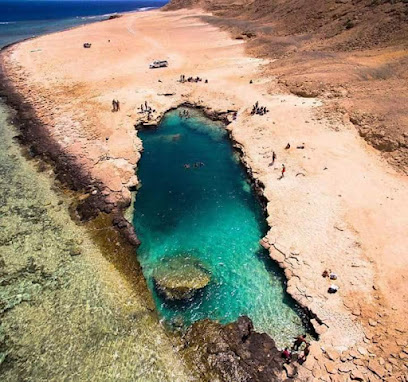
Al-Nayzak is one of the most unusual coastal attractions near Marsa Alam. Rather than a conventional stretch of open beach, visitors encounter a naturally enclosed pool of striking turquoise seawater set into a rocky shoreline. Its distinctive outline makes it particularly memorable when viewed from above. The Egyptian Tourism Authority highlights Al-Nayzak among the hidden natural attractions of Marsa Alam, alongside the region's beaches, reefs and desert landscapes.
Where Is Al-Nayzak Located?
The pool lies on Egypt's western Red Sea coast, south of Marsa Alam in Red Sea Governorate. Egyptian tourism coverage commonly describes it as approximately eight kilometres south of the town, although published distance estimates vary according to the reference point used. The attraction is a specific coastal formation, not the whole surrounding beach or a nearby resort. Visitors should navigate to the Google Maps place named Al-Nayzak and confirm the final access route locally.
A Natural Pool Beside the Red Sea
Although often called Meteor Lake, Al-Nayzak is not an inland freshwater lake. It is a natural pool associated with the Red Sea shoreline and linked to marine water. Reports and photographs describe a rocky enclosure with a connection to the surrounding sea. This relationship is important to understanding the site: its appearance may suggest a separate lake, but its coastal setting, seawater and changing water conditions are part of its identity.
The Eye-Shaped Turquoise Landscape
Al-Nayzak is especially admired for the contrast between its blue-green water, pale seabed and surrounding rock. From an elevated viewpoint, the enclosed water has an eye-like appearance, a feature noted by Egypt's official tourism website. Light, viewing angle and sea conditions change the colours visitors perceive. The setting offers a different experience from Marsa Alam's broader sandy beaches, with the pool itself forming the visual centre of the landscape.
The Story Behind the Name
The Arabic word nayzak refers to a meteor, and local tradition links this remarkable hollow to an object falling from the sky. The story has circulated among residents and visitors for years and remains closely associated with the attraction's name. It is an interesting part of local storytelling, but should be presented as a legend. A memorable place name does not by itself establish the historical occurrence of a meteorite impact.
What Is Known About Its Formation?
The Egyptian Tourism Authority explicitly states that the meteorite explanation has been debunked. The site is therefore best understood as a natural coastal formation rather than a confirmed impact crater. Available destination reporting does not establish a precise formation date or a complete, independently verified geological sequence. Visitors can appreciate the unusual rock-and-water setting without treating speculative accounts, including particular dates of a supposed impact, as established scientific facts.
Seawater, Tides and Changing Conditions
A connection with the Red Sea allows marine water to influence Al-Nayzak. Published descriptions discuss changes associated with tides, making the pool more dynamic than a permanently isolated basin. Its clear appearance should not be confused with a guarantee of constant depth, visibility or swimming safety. Water levels, wave action and access conditions can vary, so observations made on one visit should not be assumed to apply at every other time.
Swimming in the Natural Pool
Swimming is one of the activities for which Al-Nayzak is known, and Egyptian reports describe visitors entering its clear seawater. However, descriptions of its depth differ between publications, and the rocky edges require care. It should not be treated as a supervised swimming facility or assumed safe for every swimmer. Check the sea state, assess entry and exit points, avoid risky jumps and seek local guidance before entering the water.
Snorkeling and Marine Life
The connection to the sea makes Al-Nayzak a place where visitors may observe marine life. Egyptian reporting also describes coral within or around the coastal pool. Snorkeling should be approached cautiously, with attention to visibility, available space, water movement and personal ability. Do not stand on coral, chase animals or disturb the seabed. Anyone seeking a longer reef excursion can explore the wider Marsa Alam area through appropriately guided marine activities.
Planning a Responsible Visit
Al-Nayzak is best approached as a natural coastal attraction rather than a developed resort. Confirm access arrangements, sea conditions and any applicable local restrictions before setting out. Carry suitable drinking water and sun protection, and use footwear appropriate for uneven ground. Avoid assuming that lifeguards, changing rooms or other services will be available. A knowledgeable local guide can help visitors understand access conditions without relying on an unverified shortcut or unsuitable vehicle route.
Photography and Respect for the Site
The pool's unusual outline, contrasting rock and vivid water provide appealing subjects for landscape photography. Different viewpoints can reveal its connection with the open sea and the shapes of the surrounding coast. Remain on safe, permitted ground and avoid damaging fragile shoreline features while composing photographs. Aerial photography must follow any applicable local permissions and restrictions. The best images need not involve entering sensitive areas or disturbing wildlife.
Conservation and the Wider Marsa Alam Coast
Al-Nayzak belongs to a Red Sea destination celebrated for clear waters, coral habitats and marine biodiversity. Its beauty depends on responsible visitor behaviour. Take litter away, avoid touching or collecting marine organisms and keep equipment away from coral. Egypt's environmental authorities have promoted more sustainable diving and snorkeling practices to reduce pressures on reefs. Protecting this small coastal landmark also supports the broader natural appeal of Marsa Alam.